
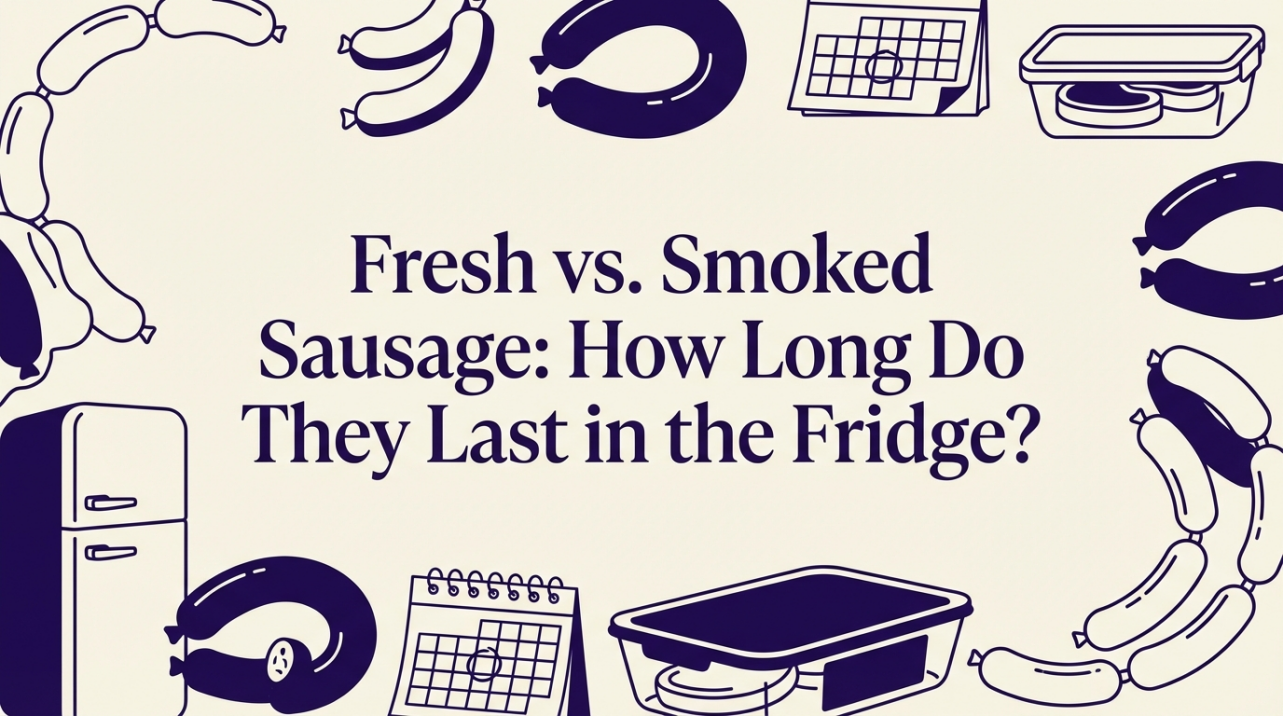
At 40°F or below, fresh raw sausage is a 1-2 day food, while most opened smoked or fully cooked sausage is safest within 7 days.
You open the fridge midweek and wonder whether the sausage you bought on the weekend is still safe for dinner. The timing gap is bigger than most people expect: raw fresh sausage usually has a 1-2 day window, while many cooked/smoked products get about a week after opening if kept cold. This guide gives you clear day limits, the temperature rules that override labels, and a practical keep-or-discard framework.

Fresh vs. Smoked Timelines
Conservative fridge windows
The FSIS sausage storage chart gives a practical baseline: fresh uncooked sausage lasts 1-2 days refrigerated, hot dogs and other cooked sausage last 2 weeks unopened and 7 days after opening, and hard/dry sausage lasts longer.
USDA cold-storage tables also list smoked breakfast sausage at 7 days and hard sausage at about 2-3 weeks in the fridge, assuming stable cold holding.
Sausage type |
Refrigerator target (conservative) |
Freezer quality target |
Fresh/raw sausage (pork, beef, poultry) |
1-2 days |
1-2 months |
Cooked/smoked sausage (opened) |
7 days |
1-2 months |
Cooked/smoked sausage (unopened) |
Up to 2 weeks |
1-2 months |
Hard/dry sausage (opened) |
About 3 weeks |
1-2 months |
Why Fresh Spoils Faster
Raw grind vs. cured/cooked processing
The core reason is process: fresh sausage is uncooked, so there is no final kill step before it reaches your kitchen, and grinding distributes surface contamination throughout the product.
Salt, smoke, and water activity
Shelf-life gains in smoked/cured products come from multiple hurdles, including heat, salt, and moisture control; salt-preservation survival curves show faster decline for several bacteria as water activity drops, with stronger reductions around aw 0.85 and below.

A common mistake is assuming smoked means shelf-stable, but refrigerated hot dogs and similar cooked sausages still have short fridge limits, and high-risk groups are advised to reheat until steaming hot.
Temperature Control Rules
Setpoints and the danger zone
Your best shelf-life control is temperature discipline, because 40°F fridge and 0°F freezer targets are the assumptions behind USDA storage times.
Microbial risk accelerates in the danger zone of 40°F to 140°F, where bacteria can double in as little as 20 minutes.

The clock outside the fridge
Perishables should follow the 2-hour rule and 1-hour hot-weather rule: refrigerate quickly, especially after cooking, and use shallow containers so heat leaves fast.
Cooking and Reheating Targets
Internal temperatures that matter
Safety depends on endpoint temperature, and the safe minimum internal temperature chart sets key sausage-relevant targets: 160°F for raw ground meats and 165°F for poultry.
For sausage specifically, uncooked sausage cooking targets are 160°F for beef/pork/lamb/veal and 165°F for turkey/chicken.
Leftovers and ready-to-eat items
Once cooked, leftovers need a second control point: reheat leftovers to 165°F, and check with a thermometer rather than color.
Labels, Packaging, and Freezing
Date labels vs. safety limits
Many shoppers over-trust package dates, but food date labels are generally quality indicators, not a replacement for time-temperature safety handling.
When you cannot use sausage in time, freezing is the right move; the FSIS storage chart notes food stays safe frozen, while 1-2 month guidance for sausage is mainly a quality window.

Shelf-stable vs. keep refrigerated
Room-temperature storage is valid only for true shelf-stable products, because shelf-stable foods are safe at room temperature until opened, while any sausage labeled Keep Refrigerated should stay cold continuously.
Practical Next Steps
A simple weekly workflow
The easiest real-world system is date-based: buy fresh sausage Sunday, cook or freeze by Tuesday night; open smoked sausage Wednesday, finish or freeze by next Wednesday.
When unsure, default to discard, because harmful bacteria cannot be reliably seen or smelled early in growth.
- Check fridge temperature daily with an appliance thermometer.
- Write the open date directly on sausage packaging.
- Store raw sausage sealed on the bottom shelf to prevent drips.
- Freeze extra portions before the fridge limit is reached.
- Reheat leftovers to 165°F before eating.
- If texture turns slimy or odor is sour/off, throw it out.
Disclaimer
This guide is provided for informational and educational purposes only. While we prioritize accuracy based on current food science, storage safety standards can vary significantly depending on specific product ingredients, regional climates, and local health regulations. This content is not a substitute for official safety protocols provided by government organizations such as the FDA or USDA. Always inspect food products for signs of spoilage and follow manufacturer-specific storage dates before consumption.
References
- USDA FSIS: Sausages and Food Safety
- USDA FSIS: Keep Food Safe! Food Safety Basics
- USDA FSIS: How Temperatures Affect Food
- USDA FSIS: Safe Minimum Internal Temperature Chart
- USDA FSIS: Hot Dogs and Food Safety
- USDA FSIS: Shelf-Stable Food Safety
- FDA: Food Product Dating
- Study PDF: Salt Preservation and Bacterial Survival in Natural Casings



Leave a comment
This site is protected by hCaptcha and the hCaptcha Privacy Policy and Terms of Service apply.