








Calm, specific negotiation helps teens follow through on chores without turning every reminder into a fight.
Does your evening fall apart the same way again and again, with dishes sitting in the sink, a teen saying "later," and everyone getting louder by the minute? Families usually get better results when chores are visible, routine, and tied to clear follow-through instead of emotion. A practical plan for talking about chores, assigning them, and enforcing them can protect both your standards and your relationship.
Why yelling usually makes chores worse
Repeated nagging and yelling often train teens to wait you out instead of act. Once a teen learns that the first few reminders do not matter, your volume goes up while your influence goes down.
Negotiation is not the same as giving in. A healthy version keeps the boundary in place while making room for the teen's perspective, which is how boundaries with teens are described in practical parenting guidance. In real homes, this looks less like "Do it because I said so" and more like "The trash still needs to go out tonight, so let's figure out when you're doing it."
That distinction matters because many teens are not resisting only the chore. They are also resisting the feeling of being controlled, judged, or interrupted. Relationship-based guidance on teen chore refusal notes that refusal often signals stress, hurt, or a push for autonomy, not simple laziness. If your teen snaps when you ask for help at 8:30 PM after a long practice and two hours of homework, timing may be part of the problem.

What negotiation actually means at home
Respectful negotiation means the responsibility stays, but the path can flex. Advice on negotiating with your teen explains this clearly: you can accept a different time, sequence, or method if the job still gets done and both sides stay civil.
A simple definition helps. Housework negotiation is a calm, bounded conversation about who will do what, by when, and what happens if it is not done. It is not a debate about whether a teen should contribute at all. Family life works better when chores are treated as shared responsibility rather than punishment, which is also the core message in chores and long-term success.
One practical shift reduces friction fast: stop asking for vague help. Instead of "Can you help more around here," assign a recurring, visible job, such as dishwasher duty every Sunday night or bringing in groceries every Tuesday after shopping. Vague expectations create the exact argument most parents want to avoid because the teen feels accused and the parent feels ignored.
How to start the conversation without a fight
The best time to negotiate chores is not the moment you are already angry. Guidance on consequences for skipped chores recommends avoiding discipline when you are heated because reactive punishment is usually harsher and less effective than a calm response.
A useful script is short and plain. You can say, "We keep getting stuck on laundry. I'm not going to yell about it anymore. You do need to handle your laundry each week, so let's decide what day and what happens if it doesn't get done." That opening works because it names the pattern, removes the threat, and holds the line.

Then listen first. The guidance on boundaries with teens emphasizes hearing the teen's perspective before defending the rule. A teen might tell you the problem is not unloading the dishwasher itself but being asked right when an online game starts, or being assigned a 40-minute job on a night packed with studying. You do not have to agree with every complaint to use the information well.
Build a deal that is specific enough to survive real life
Most chore agreements fail because they are too fuzzy. Stronger systems define the task, the timing, the standard, and the consequence. Home-management advice on repeatable home systems is useful here because chores stick better when they become obvious, easy, and routine.
Imagine a teen who always argues about trash night. A weak agreement is "Take out the trash more often." A workable agreement is "Check kitchen and bathroom trash right after dinner on Tuesday and Friday, and take the bins to the curb by 8:00 PM on Wednesday." That version removes guesswork.

This is also where routine beats motivation. Family organization guidance on household organization routines stresses that habit-building should come before fancy tools. If the dishwasher is always emptied before school and towels are always folded before screen time, your teen does not need to feel inspired. They just need to follow the family rhythm.
Approach |
Why it helps |
Watch-out |
Vague request |
Feels flexible in the moment |
Creates arguments about what "helping" means |
Specific recurring job |
Reduces reminders and excuses |
Needs teaching at the start |
Calm negotiation with deadline |
Preserves dignity and accountability |
Fails if the consequence is unclear |
Yelling and repeated warnings |
May create short-term movement |
Usually weakens follow-through over time |
Consequences that teach instead of explode
The most effective consequence is usually direct and related. Guidance on consequences for skipped chores recommends stopping rescue behavior. If your teen does not wash their clothes, the natural result is fewer clean clothes. If they skip unloading the dishwasher, the evening kitchen routine gets delayed and a privilege may wait until the work is complete.
That does not mean every missed chore deserves a massive punishment. Relationship-focused advice on motivating teens to do chores warns that oversized consequences for small failures can backfire. Losing an entire weekend over one missed bathroom wipe-down usually creates resentment, not responsibility.
A simple household rule often works better: work before screens, rides, or optional favors. If a 20-minute task blocks 90 minutes of gaming, the connection is easy to understand. The key is calm delivery. You are not arguing the verdict; you are enforcing the agreement.

When flexibility is smart, not weak
Good negotiation leaves room for real-life exceptions. Guidance on negotiating with your teen gives the classic example of allowing a delay when a teen has a meaningful social commitment, as long as the new commitment is specific and followed through.
That flexibility matters because overloaded teens are still learning how to balance school, activities, friendships, and home. The advice in chores and long-term success supports staying steady on the expectation while showing empathy during unusually stressful periods like exams or a rough day. In practice, that might mean moving bathroom cleaning from Thursday night to Saturday morning, not canceling it altogether.
The line to hold is simple: feelings are negotiable, but responsibility is not. You can validate "I know this is annoying" without dropping the standard.
How shared household systems reduce conflict
A visible system cuts down on emotional memory battles. Shared tools for family organization apps and digital calendars help because the chore does not live only in your voice; it lives in a shared place everyone can see.
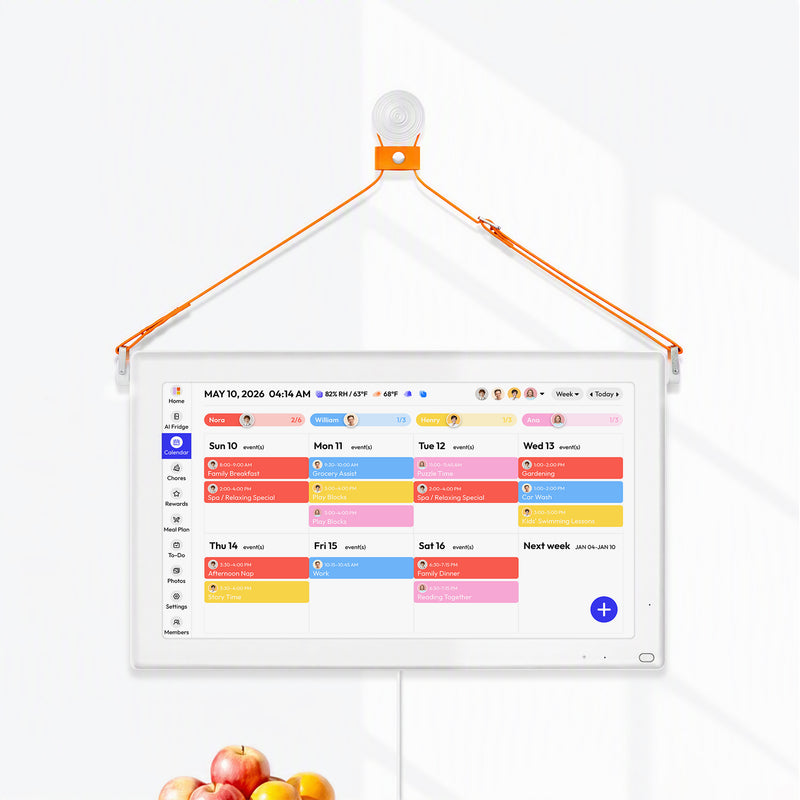
For many families, the simplest win is a central command center with color-coded responsibilities and recurring reminders. Research on digital family calendars points to the same benefit: visibility reduces nagging because the task is already there, attached to a person and a deadline. If your family is often in different places, a shared app may work better. If everyone passes through the kitchen every morning, a wall display may be stronger because it becomes the home's single source of truth.
The tool is not the solution by itself. It works best after you already have a clear agreement. A screen cannot fix a vague standard, but it can make a good standard easier to remember and harder to dispute.
What to do if your teen still refuses
If refusal continues, reduce the problem size. Guidance on getting kids to do chores without an argument recommends changing one chore at a time rather than trying to repair the entire household at once. Pick the chore that causes the most daily friction and solve that one first.
Then check whether the teen actually knows how to do the task to your standard. Some resistance is skill failure disguised as attitude. If "clean the bathroom" really means 10 separate steps, teach those steps once, do the first round together, and then step back. That approach fits both home-systems advice and teen chore guidance: make the job visible, easy to start, and satisfying to complete.
A quieter house usually starts with fewer words, clearer expectations, and steadier follow-through. When your teen knows you will listen, negotiate the reasonable parts, and calmly hold the rest, chores begin to feel less like a daily battle and more like ordinary family life.


