



Couples usually fight less about family planning when the work is visible, clearly owned, and reviewed in a short routine instead of passed back and forth through reminders. A shared calendar and a simple home planning station often do more than another long talk.
If your week keeps blowing up over school forms, grocery gaps, pickup confusion, or the question of who was “supposed to remember,” the problem is usually the system, not just the mood. Families who name the work, assign it, and keep it where both adults can see it tend to get fewer last-minute surprises and cleaner handoffs. What follows will help you decide what to assign, what to make visible, and how to check in without turning Sunday night into a staff meeting.
Why Planning Turns Into Conflict
Invisible work still counts as work
Unequal household labor is a common source of relationship tension because the hard part is often not the dish, the lunch, or the permission slip itself. It is keeping track of what needs to happen next. That is the mental load: the planning, remembering, following up, and noticing when something is about to fall through.

This gets worse when one partner is the default project manager for the home. The same source describes how conflict often grows when tasks are assigned indirectly through reminders, forwarded messages, and “can you just” requests. That pattern makes one person the owner and the other person the helper, even if both adults feel busy.
Ad hoc reminders are not a planning system
A structured planning exercise for couples suggests setting aside at least 30 minutes when both people are not too tired or stressed, then listing current responsibilities separately before comparing notes. That matters because many couples are arguing from different mental maps. One person is counting dinner, camp forms, and birthday gifts. The other is counting trash, yard work, and the car inspection.
Once those lists are on paper, the argument usually gets more specific and more useful. Instead of “I do everything,” the conversation becomes “You handle dentist appointments, but I still track every school email, every meal plan, and every field trip form.” That is a much easier problem to solve.
Build One Shared Source of Truth
Use digital for time and visible space for handoffs
A shared household app setup works best when each tool has one job: a calendar for events, a meal planner for food, and a shared list for chores or purchases. Trying to run the whole family through text messages usually creates noise, not clarity.
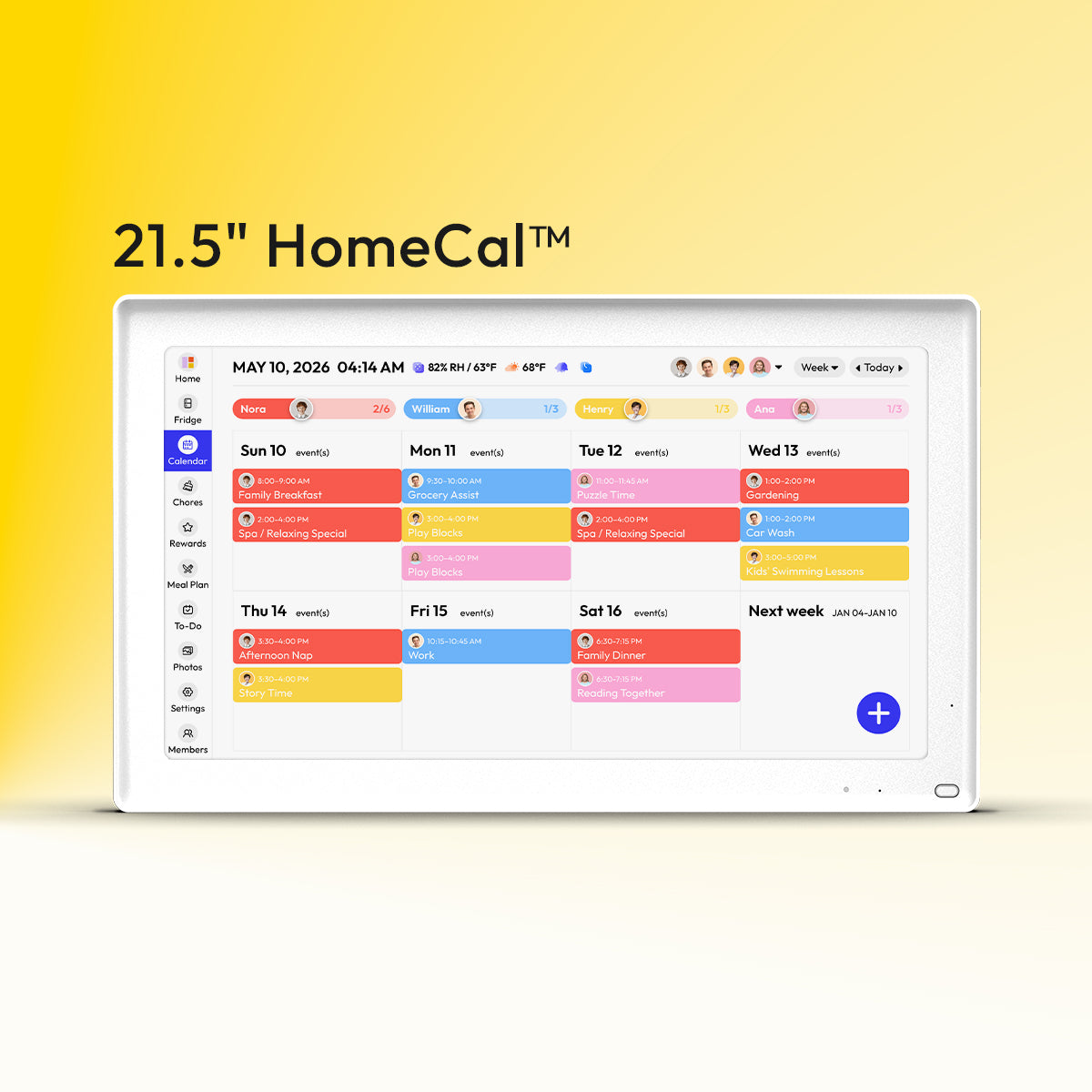
A challenge of digital planning is accuracy when information is scattered across channels. For home life, that usually means this rule: chats are for conversation, but the calendar is the source of truth. If a pediatrician visit, soccer game, daycare closure, or bill due date is not on the shared calendar, it does not count as “communicated.” For households that want that shared view in a common area, a wall-mounted digital calendar such as the Everblog 21.5" Digital Calendar can keep schedules, chores, and handoffs visible in one place.
Put the command center where life already happens
A family command center works best when it is visible, easy to use, and placed where people already pass through, such as the kitchen, mudroom, garage entry, or back hallway. Good placement matters more than perfect decor. A beautiful setup in a spare room usually becomes storage, not support.

A centralized home space for schedules and papers should cover the items that create the most repeat friction in your house. For many couples, that means a monthly calendar, a weekly meal plan, one inbox for school papers and mail, hooks for keys or backpacks, and a small whiteboard for time-sensitive notes. If children are old enough to participate, labels and simple bins help them put things in the right place without asking.
Give each person a lane people can actually see
A designated family area for calendars, to-do lists, and labeled bins works especially well when each person has a mini station. That can be as simple as one basket per person, one school folder per child, and one place for forms waiting on a signature. Visibility reduces the number of verbal reminders needed later.
Split Ownership, Not Just Tasks
Assign categories, not random emergencies
A shared responsibility system is useful here because it treats household work as named responsibilities instead of floating favors. In practice, that means one partner may fully own meals this week, while the other owns school logistics, pet care, or bill tracking. Ownership should include planning, execution, and follow-through, not just the physical task.
This is more stable than dividing work only when something is on fire. For example, “You do dinner on Tuesdays” is narrower than “You own weekday meal planning, including checking the pantry, choosing meals, and making sure the grocery list is ready by Friday.” The second version prevents the invisible prep work from sliding back onto the other partner.
Define what “done” means before the week gets busy
A task-mapping exercise for couples suggests reviewing current duties in categories like food, chores, bills, pets, and children’s scheduling, then marking what each partner will keep, share, or revisit. That works because it forces a conversation about standards. “Handle the school paperwork” needs a shared definition. Does that include reading the email, printing the form, signing it, putting it back in the backpack, and adding the due date to the calendar? Usually it should.
If one partner struggles with executive function, that means the brain skills used to start, sequence, remember, and finish tasks, the answer is not more criticism. What may help is reducing memory demands with recurring reminders, clearer deadlines, step-by-step handoffs, and one visible place for papers and supplies. These tools do not treat ADHD or stress, but they can reduce avoidable misses.
Keep the Weekly Check-In Short
A short script works better than a long debate
A 30-minute planning conversation is often enough if it has a clear job. Many couples do well with this order: review the calendar, confirm transportation and pickups, choose meals, check chores that affect the week, and flag anything unusual such as travel, late meetings, or school events. The goal is not to discuss every detail of the household. The goal is to surface collisions before Tuesday finds them for you.

One practical version looks like this: 10 minutes for schedule, 10 minutes for food and supplies, 10 minutes for chores and exceptions. If the family is in a heavy season, such as a new baby, sports sign-up week, or a job change, keep the same structure and shorten the expectations. A smaller plan that both people can maintain is better than an ambitious one that collapses by Wednesday.
Review exceptions, not every routine
A digital family calendar can reduce some of the mental chaos because routine items do not need to be renegotiated every week. Recurring trash day, standing therapy, piano lessons, and the monthly dog medication can live in the system. The meeting is then for changes, conflicts, and handoffs.
That is especially helpful for couples who get into the same fight every week. If bedtime ownership, grocery pickup, and Friday laundry are already assigned, the conversation can stay focused on what is different: a teacher conference at 4:30 PM, a work dinner, a sick child, or a weekend birthday party that changes dinner plans.
Choose Tools by the Friction Point
Start with the cheapest setup that solves the real problem
A budget-friendly command center can be built for about $75 if the main issue is paper, backpacks, keys, and forgotten forms. For many households, that is enough. A whiteboard, wall calendar, a few hooks, bins, and a mail slot can remove a surprising amount of daily friction.
Traditional paper and dry-erase calendar options are also much cheaper than large digital displays. Paper calendars may cost about $9 to $19, while dry-erase wall calendars often land around $45 to $90. If your biggest pain point is simply seeing the week at a glance, those are sensible starting points.
Use a digital wall calendar when visibility is the bottleneck
The main advantage of digital wall calendars is household visibility. A phone calendar works for the adult holding the phone. A wall display works for the partner making coffee, the child grabbing a backpack, and the grandparent helping with pickup. That difference matters in busy homes.

The trade-off is cost. Some digital family calendar displays range from about $199 to $899.99, and some add subscriptions. They make more sense when the household already relies on synced calendars and has enough moving parts to justify a shared screen in a common area. If your calendar sits in a home office instead of the kitchen or entryway, much of the value disappears.
Keep apps in supporting roles
A shared calendar app with reminders and notes is usually the best first digital tool because time-based conflicts create many household arguments. Meal-planning and grocery apps help next if dinner and shopping are the repeated pain points. Chore and purchase lists help when errands and supplies keep falling on one person’s memory.
The key is not to buy more tools than your system can hold. One calendar, one meal plan, one task list, and one visible drop zone is usually enough for a couple to tell whether the system is helping.
FAQ
Q: Should we split family planning 50/50?
A: Not always. Equal does not have to mean identical. What matters more is that both adults agree the division is fair, that both people’s time is treated as valuable, and that ownership is clear enough that one partner is not quietly managing the other.
Q: What if one partner forgets things unless they are reminded?
A: Build the reminder into the system instead of into the relationship. Recurring calendar events, visible whiteboards, labeled bins, and due dates on the wall are often more effective than repeated verbal prompts. If forgetfulness is persistent or tied to stress, keep the supports simple and highly visible.
Q: Do we need a digital wall calendar to make this work?
A: No. Many couples do fine with shared phone calendars plus a paper or dry-erase command center near the kitchen or entry. A larger digital display is most useful when the household has many overlapping schedules and needs everyone to see the same plan without opening an app.
Practical Next Steps
If your planning talks keep turning into blame, reduce the number of decisions you make in real time. Put the routine work into a shared system, and use your weekly check-in to handle only what changed.
- Pick one shared calendar and make it the only place for appointments, pickups, school events, and bill due dates.
- Create one visible command center with a calendar, paper inbox, hooks, and a short meal or to-do board.
- List the current tasks each partner already manages, then group them into categories like meals, school, bills, chores, and pets.
- Assign one owner to each category for the next two weeks, including planning and follow-through.
- Define what “done” means for the categories that cause the most confusion.
- Hold one 15- to 30-minute check-in each week, and review only changes, conflicts, and handoffs.
- Adjust the system after two weeks based on what you still forgot, lost, or argued about.
Disclaimer
This article is for household planning education only. It is not a substitute for mental health care, medical advice, legal advice, or crisis support. If safety, custody orders, or a diagnosed condition are involved, work with the appropriate licensed professional.
References
- The Family Planning Conversation Goes Digital
- The 10 Easiest Family Command Centers to Get Organized
- 21 Smart Family Command Center Ideas
- Apps Every Couple Should Download Before Moving In Together
- How to Divide Household Chores Fairly
- The Ultimate DIY Family Command Center Guide
- Structured planning exercise for couples
- A Shared Calendar Is the Key to Our Successful Marriage
- Achieve a Successful Relationship by Sharing Household Responsibilities


