





A wall-mounted digital calendar gives families one visible place to see schedules, chores, meals, and reminders. When it works well, it reduces confusion by making the weekly plan easy for everyone to check.
A digital calendar for wall is a shared screen that shows your family’s schedule in one visible place, usually syncing with the calendars already on your cell phones. In a busy home, it works best when it becomes the one spot everyone checks for plans, chores, meals, and reminders.
If your mornings keep starting with missed practices, forgotten permission slips, and the daily “What’s for dinner?” question, this kind of setup can help. Families often feel the benefit quickly when one visible screen replaces scattered notes and mental tracking, because everyone can see the same plan without relying on one parent to hold it all. This article explains what a wall calendar does, how it fits into real family routines, and how to make it useful instead of just another screen.
What a digital calendar for wall actually is
A shared household scheduling display puts appointments and events on a larger, always-visible screen instead of hiding them inside individual cell phones. In practical terms, it sits in a kitchen, hallway, mudroom, or other high-traffic spot and becomes the family’s common reference point.
What makes it different from a regular phone calendar is not just the screen size. In a family home, it usually combines several moving parts into one place: shared events, school activities, recurring reminders, chores, meal plans, and sometimes grocery lists or notes. Some services present this as a shared dashboard for everyday family life, which is a useful way to think about the category. The calendar is only one piece; its real job is reducing coordination friction.

Diagram showing multiple calendar sources syncing to one family display
That matters because most families are not struggling with the idea of scheduling. They are struggling with visibility. One parent may have the pediatrician visit on a phone, another may have soccer practice in a work calendar, and a child’s spirit day may still be buried in an email. A wall calendar pulls those pieces into one glanceable system.
How it works in real life
Most digital family calendar systems work in a straightforward way: you plug in the display, connect it to Wi-Fi, install or sign in to a companion app, and link the calendars you already use. After that, updates happen automatically, so adding an orthodontist appointment on your cell phone can make it appear on the wall screen without rewriting anything by hand.
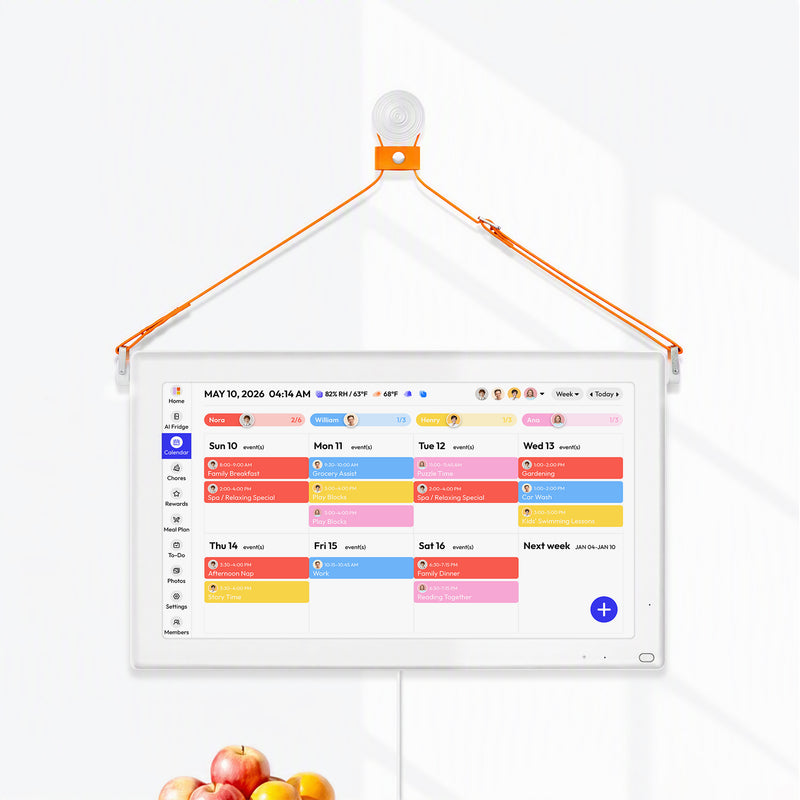
In a busy home, the screen usually becomes a live command center rather than a passive calendar. A shared home planning screen may show who has pickup duty, which child has a late practice, what leftovers are planned for Thursday, and which chores still need to be checked off before bedtime. That is why many of these products add color coding, task assignment, dinner planning, and child-friendly chore tracking instead of stopping at appointments.
Here is the simplest way to picture the workflow.
Part of the system |
How it works at home |
Why families use it |
Shared calendar sync |
Connects phone calendars to one household screen |
Everyone sees the same schedule |
Color-coded profiles |
Gives each person a color or profile |
Reduces mix-ups at a glance |
Adds recurring routines and assignments |
Makes responsibility visible |
|
Places dinners beside the week’s events |
Cuts nightly decision fatigue |
|
Lets adults edit from anywhere |
Keeps the wall screen current |
A common example is Sunday evening planning. One parent adds school events from email, another adds work travel, and the children can see when they need gym clothes, library books, or early pickup that week. By Monday morning, the screen is not just decorative; it has already eliminated several separate conversations.

Family gathered around wall calendar during Sunday planning session
Why a wall display can work better than a phone alone
Research on paper versus mobile calendars is surprisingly helpful here, even if you prefer digital tools. Across studies highlighted by Columbia Business School and echoed by Cal State Fullerton and Baylor, paper-calendar users tended to create higher-quality plans and follow through more successfully than mobile-calendar users. The key reason was not nostalgia. It was the “big picture” effect: seeing more of the schedule at once helps people notice conflicts, sequence tasks, and plan more realistically.
That finding matters because a wall calendar can copy one of paper’s biggest strengths while keeping digital convenience. The larger-screen planning advice from the University of Washington makes a similar point from another angle: phones alone do not provide enough visibility for effective planning, and people should review their calendar on a larger screen daily. In family life, that often means fewer hidden surprises because the week is not trapped behind tiny, day-by-day phone views.
There is an important nuance here. The research does not mean digital calendars are bad. It suggests they work poorly when they behave like a narrow stream of isolated events. Baylor’s summary of the same studies notes that digital users improved when they were prompted to think relationally and use broader views. In plain language, the problem is not that the screen is digital; the problem is planning without seeing how Tuesday’s dentist appointment collides with Wednesday’s recital costume pickup and Thursday’s late meeting.

Comparison of phone calendar view versus wall display full-week view
Where families get the biggest payoff
A shared family calendar app reduces double-booking, missed activities, and last-minute scrambles when everyone has real-time visibility into commitments. In homes with children, the payoff is often emotional as much as logistical. Fewer surprises usually mean fewer arguments at the doorway, fewer frantic texts about pickup changes, and less of one adult carrying the whole plan mentally.
The kitchen tends to be the strongest location because visibility drives adoption. Consumer Reports found that usefulness depended heavily on where the device was installed, and high-traffic spots worked better than tucked-away offices. That matches what usually happens in practice: a screen no one passes becomes an expensive gadget, while a screen near the coffee maker becomes part of the morning rhythm.
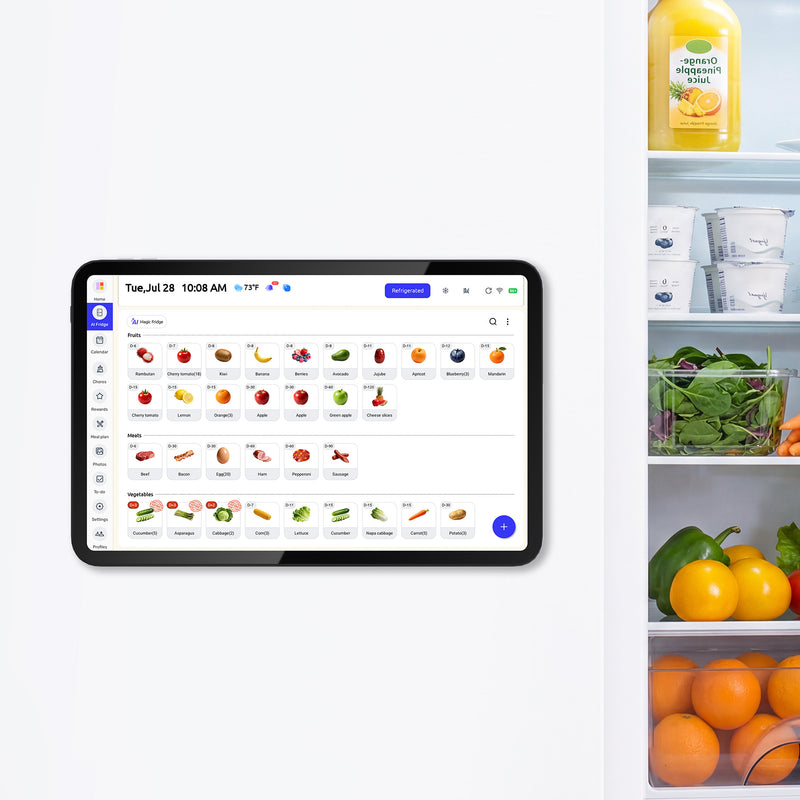
This is also why fridge-based setups appeal to many households. A digital fridge calendar setup or magnetic command-center model turns a surface families already approach several times a day into the place where schedules, meals, and chores live together. For parents, that often feels calmer than juggling separate apps for every function.

Digital calendar mounted in high-traffic kitchen area beside refrigerator
Pros, limits, and what to watch before buying
A shared household organizer can make family life feel more coordinated because it creates one source of truth. Automatic syncing saves duplicate entry. Large-screen visibility helps children participate. Built-in chores, meal plans, and lists can reduce the invisible manager role that often lands on one adult.
The drawbacks are real too. Digital wall calendars are expensive for a single-purpose device, and some systems place advanced features behind paid add-ons or subscriptions. Some products separate optional paid functions, while others highlight convenience tools such as import assistance and faster meal planning. That can be useful, but it also means families should check exactly what is included before assuming the hardware alone solves everything.
Another limit is behavioral. A wall calendar does not fix a household that never enters events consistently. It works best when the family already has a basic habit of putting appointments somewhere digital, then uses the wall display to make that information visible and shared. If the data going in is incomplete, the screen will simply display incomplete data more neatly.
How to make one work without adding stress
A weekly review habit is what turns the screen from a novelty into a family system. The most stable routine is usually a short Sunday check-in and two quick daily glances, one in the morning and one in the evening. That rhythm catches pinch points early, such as three activities landing on the same night or a project deadline stacking on top of a school event.
Adoption matters more than fancy features. Practical family-calendar habits consistently come back to a few practices that hold up: use one master calendar, color-code by person, enter plans immediately, and keep enough detail in each event that nobody has to hunt for the address or ask what time to leave. A reminder that says “dentist” is only half useful; “dentist, 4:00 PM, insurance card, leave by 3:25 PM” is what reduces stress.
For many families, the most effective setup is also the simplest. Keep the screen in a place everyone passes, use a weekly or monthly view by default, sync only the calendars that truly matter, and let the wall display support the life you already live instead of forcing a whole new system.
A good digital wall calendar does not create family harmony on its own. What it can do is make the plan visible, shared, and easier to follow, which is often enough to make a hectic home feel more predictable and a little lighter.


