




A digital desk calendar is usually the better choice when one person needs a close-range view beside a computer. A family calendar display makes more sense when several people need to see the same schedule in a kitchen, hallway, or other shared space.
The distinction is not simply small screen versus large screen. Audience, viewing distance, placement, update access, and privacy determine whether a calendar becomes useful or turns into another screen that only one person checks.
Digital Desk Calendar vs Family Calendar Display: What Is the Difference?
A desk calendar serves one nearby user; a family display serves several people moving through a shared space. Start with the schedule failure, not the product label.
|
If you need to... |
Better starting point |
Main reason |
Check before buying |
|
See your next meeting beside a monitor |
Digital desk calendar |
Close-range focus |
Desk footprint and notification control |
|
Protect detailed work appointments |
Digital desk calendar |
Private placement |
Whether shared calendars can be hidden |
|
Show pickups and practices to everyone |
Family calendar display |
Shared visibility |
Readability from normal room positions |
|
Combine schedules, chores, meals, and lists |
Family calendar display |
More room for household context |
Which modules are included or optional |
|
Serve two people in a small kitchen |
Either format |
Habit matters more than category |
Whether both people can see and update it |
Audience, distance, and update location decide the category
Ask three questions. Who needs the information? From where will they read it? Where will changes be made? A screen beside one person's keyboard may show a shared calendar, yet it cannot help a child checking tomorrow's practice from the kitchen. If plans change during pickup, the person making the change also needs a reliable remote workflow.
The workflow matters more than the product label
A tablet can run family-calendar software, and a family organizer can sit on a stand. Test the complete loop: create an event, change it somewhere else, confirm who sees it, and check whether private details stay private.

What a Digital Desk Calendar Does Best
Personal desk displays work best for close-range focus, compact placement, and an individual's workday. They keep selected information visible without turning a shared room into a public agenda.
How Does a Digital Desk Calendar Help Personal Productivity?
A desktop digital calendar can show the next meeting, daily agenda, focus blocks, countdowns, or a small task list. It does not need every household chore and meal if its job is to answer, “What do I need to do next?”
Why Choose a Digital Desk Calendar for Private Scheduling?
A calendar near its owner can show client names, medical appointments, or interview reminders without displaying them to visitors. In a home office, detailed work events can remain on the desk while the household calendar receives only the time blocks others need.
Why Does Screen Size Matter for a Desk Calendar?
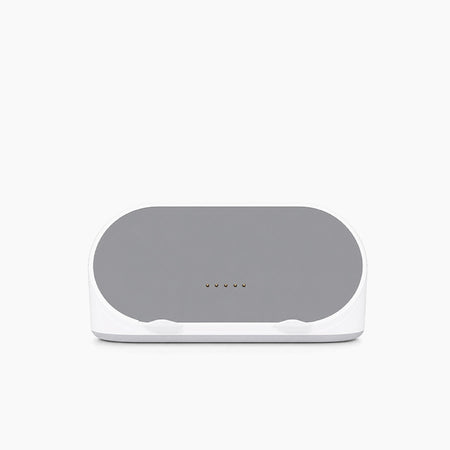
Smaller screens demand less space and remain within touch range. Before buying, measure the base, cable bend, and stand depth, not just the diagonal screen size. A slim display can still compete with a keyboard, lamp, and laptop stand.
Where Personal Desk Calendars Break Down for Families
A display beside one person's keyboard is not a shared household surface unless everyone can see and update it reliably. Calendar sharing alone does not create shared awareness.
Desk placement hides household changes
Suppose soccer practice moves from 5:00 to 4:30. One parent updates the calendar at work, but the only persistent display sits in a closed office. The person handling pickup may never pass it. The data is shared; the information is not visible where the decision happens.
One person's device can become another private system
If only one adult understands the app or editing process, everyone else keeps asking that person for answers. A shared system should let each responsible person check and update appropriate information without borrowing someone else's device.
Small screens trade overview for tapping and scrolling
A day view may fit well on a compact screen. Four calendars plus chores, meals, and lists may require more scrolling. That becomes friction when several people need a quick household overview.
What a Family Calendar Display Adds
A family display prioritizes shared visibility, multi-user context, and household routines over personal desk focus. The screen becomes a common reference point rather than an extension of one person's workstation.
A shared display keeps the week visible in a common space
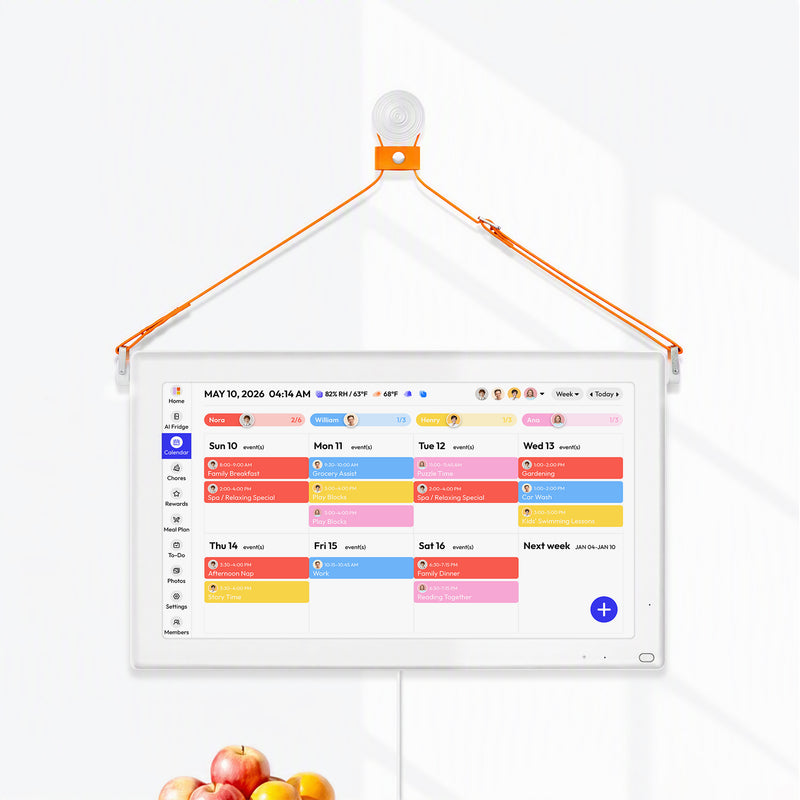
A well-placed family calendar display can make ownership and conflicts easier to scan through member colors and day, week, or month views. Those capabilities vary by product, so verify the view and font size on the actual device.
An August 2026 WIRED hands-on comparison describes this category as screens that bring existing online calendars into a central household view, often alongside chores or meal-planning tools. That review shows how central visibility can work in one home; it does not establish a universal adoption result.
Remote and local updates keep the shared view current
Do not stop at the word “sync.” Check the provider, direction, editable calendars, permissions, and recovery after a failed connection. A household discussion about kitchen calendar displays contains conflicting reports about two-way sync. That reveals what shoppers need clarified, not a reliable product specification.
Household modules add context beyond appointments
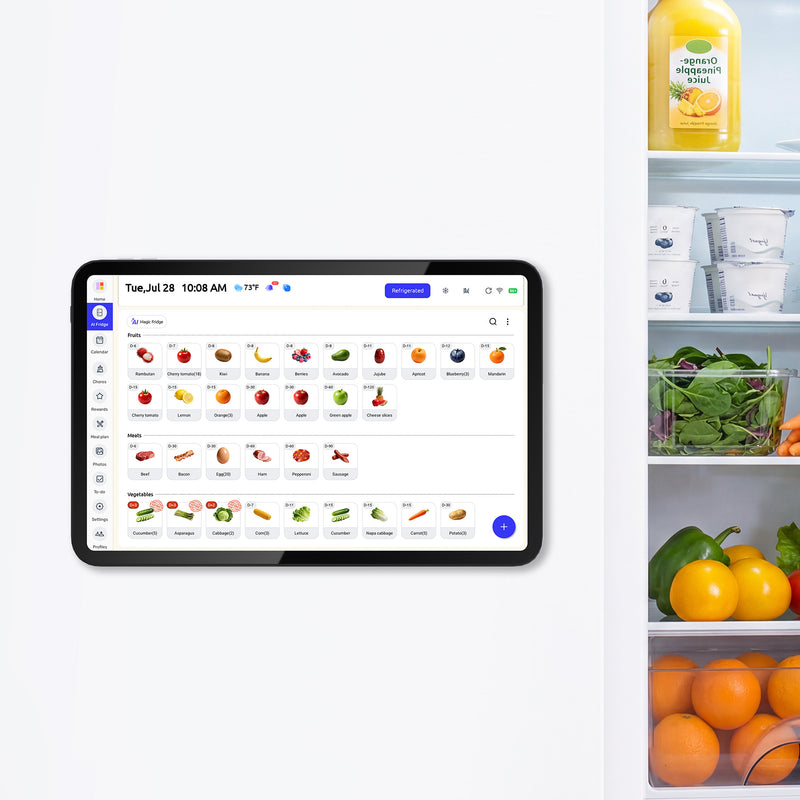
Some family displays include chores, meal plans, grocery lists, or food information. These are optional category capabilities. A module earns its place when it replaces a real handoff, such as connecting Tuesday's late practice with a simple dinner plan.

Digital Desk Calendar vs Family Calendar Display: Feature Comparison
Use a decision table instead of counting features. The better device is the one that places the right amount of information in front of the people responsible for acting on it.
|
Criterion |
Digital desk calendar advantage |
Family display advantage |
Question to ask |
|
Primary users |
Optimized for one person |
Designed for several household members |
Who must act without asking another person? |
|
Viewing distance |
Clear at seated distance |
Can support room-level visibility |
Can the smallest user read the week from a normal position? |
|
Placement |
Small personal footprint |
Central wall or countertop presence |
Where does the schedule decision happen? |
|
Privacy |
Detailed events stay near the owner |
Shared events are easier to see |
Which titles must be hidden or shortened? |
|
Calendar sync |
May need only one account |
Often needs several providers or profiles |
Is sync one-way or two-way for each account? |
|
Input methods |
Keyboard or phone edits may be enough |
Local touch plus remote updates may help |
Can every responsible person make a correction? |
|
Power and cable |
May share a desk charging area |
Needs a safe, visible power plan |
Is it rechargeable, corded, or meant to stay plugged in? |
|
Household modules |
Minimal tools reduce distraction |
Chores, meals, and lists can share context |
Which module replaces an existing task? |
Which Calendar Display Is Right for Your Household?
The same calendar screen can be right or wrong depending on where coordination fails. “Desk,” “countertop,” and “wall” describe positions; they do not define the audience.
|
Household scenario |
Stronger fit |
Why |
Main risk |
|
One-person home office |
Personal desk display |
Private, close, focused daily agenda |
Household events remain elsewhere |
|
Couple in a small apartment |
Either |
Two people can share a compact counter display if both update it |
One partner becomes the calendar manager |
|
Family with school, sports, and chores |
Shared family display |
Central week view provides more multi-person context |
Poor placement makes a large screen easy to ignore |
|
Mixed Google, Apple, and Outlook household |
Depends on verified sync |
Provider support matters more than size |
Imported calendars may have different edit permissions |
Best for Personal Work: Digital Desk Calendar
Choose a personal display when your problem is checking the next work block without opening another tab. Share limited busy blocks with the household instead of exposing detailed work events.
Best for Couples: Shared or Compact Calendar Displays
Two people may not need a large wall screen. A countertop calendar can work if both can read and update it. Try the shared-calendar habit for a week before buying hardware to learn whether the gap is visibility or participation.
Best for Families: Shared Calendar Display
School pickups, practices, appointments, and meals create conflicts across people. A central display can expose them earlier if the week view is readable and remote changes reach the screen. Then use the guide on how to choose a family digital calendar for model-level criteria.
How to Choose the Right Location for a Digital Calendar Display
List every calendar provider and account type before shopping. Decide what happens if Wi-Fi fails or an account disconnects. A short manual list can preserve tomorrow's essentials while the connection is restored.
Run the Placement and Visibility Test Before You Buy
Test the intended location with a paper or cardboard mockup before choosing a screen. This editorial framework does not claim hands-on results; it gives you a repeatable way to collect your own evidence.
Tape out the device's published width and height, then place sample event text inside the outline. Check it from a seated desk position, the usual countertop pause point, and the farthest place where a family member is expected to read it. Repeat in morning and afternoon light.
|
Test item |
Desk position |
Counter position |
Across-room position |
Pass condition |
|
Event time and owner |
____ |
____ |
____ |
Readable without moving closer |
|
Full week overview |
____ |
____ |
____ |
Conflicts visible without opening another view |
|
Touch reach |
____ |
____ |
____ |
Safe reach for intended users |
|
Glare |
____ |
____ |
____ |
Text remains readable at the brightest time |
|
Private-event exposure |
____ |
____ |
____ |
Sensitive titles are hidden from visitors |
|
Cable and base footprint |
____ |
____ |
____ |
No blocked prep area, walkway, or drawer |
|
Update workflow |
____ |
____ |
____ |
A remote change appears where expected |
Placement must account for reach, glare, traffic, wall strength, counter depth, and outlet location. The guide to under-cabinet versus countertop calendar placement provides a room-specific check.
A rechargeable screen avoids a permanent cord but needs a charging habit. A corded display needs a safe outlet and cable route. Shared placement also requires privacy controls for work titles, medical details, school information, and visitor sightlines.
When a Desk Calendar Is No Longer Enough
A digital desk calendar works well when one person needs meetings, tasks, and the next appointment within arm’s reach.
But family planning creates a different problem. If several people need to check school pickups, practices, meals, chores, or schedule changes, the calendar needs to live where everyone can see it—not beside one person’s keyboard.
That is when a shared family display starts to make more sense.
Choose the Display Around Where Your Family Looks
Everblog offers two examples of this shared approach.
The 13.4-inch FridgeCal™ mounts magnetically on the fridge and uses a rechargeable battery. It suits kitchens where family members naturally stop to check plans, meals, or lists.
The 21.5-inch HomeCal™ provides a larger shared view for wall or countertop placement. Its larger screen is better suited to households that want the weekly schedule visible from farther across a common space.
| If you need... | Better fit |
| One person's agenda beside a computer | Digital desk calendar |
| Shared kitchen visibility in less space | 13.4" FridgeCal™ |
| A larger family overview in a common area | 21.5" HomeCal™ |
Both Everblog models support shared family functions such as calendar sync, member color coding, chores, meal planning, lists, and phone access. The main decision is therefore less about features and more about where the household needs to see the information.
If only you need the calendar, keep it personal. If everyone keeps asking, “What’s happening today?”, a centrally visible family display may solve the bigger problem.
Frequently Asked Questions
What is a digital desk calendar?
A digital desk calendar is a small electronic display that keeps calendar information visible near a personal workstation or counter. It usually prioritizes close-range daily information over an across-room family overview.
Can a digital desk calendar work for a family?
Yes, if every intended user can see and update it during normal routines. Its size and private placement become limitations when family members must walk into one person's workspace or scroll through several calendars.
What screen size is best for a family calendar?
There is no universal best size. Choose from measured viewing distance, information density, room layout, font readability, and touch reach. Test an accurately sized mockup rather than relying on diagonal screen size alone.
Is a wall calendar better than a countertop display?
A wall display offers fixed visibility and preserves counter space. A countertop display may be easier to touch, move, and install. Outlet location, glare, traffic, stand depth, and who must reach the screen determine the better placement.
Can a large family display work on a desk?
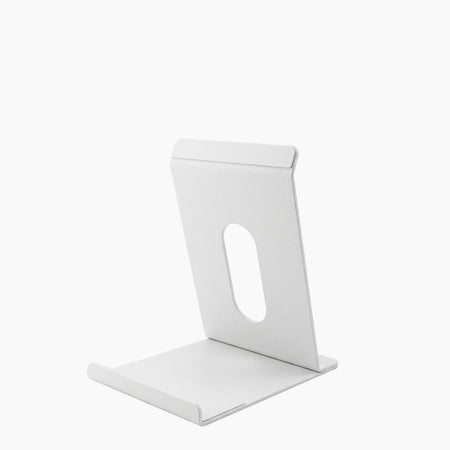
It can, but measure the complete footprint first. A 21.5-inch display is closer to a monitor than a compact desk accessory, and a stand may be optional rather than included. It suits a dedicated household planning desk or deep counter better than a crowded workstation.
The purchase decision becomes clearer when you stop comparing labels. Run the Placement and Visibility Test in the exact spot, with the people who will use the calendar. Choose a compact personal screen for close-range focus, a shared display for household visibility, or no new hardware if a current shared calendar already fixes the real failure.


