



The Real Reason You Keep Switching Systems
The pattern is consistent enough to be uncomfortable. You try a new productivity app or planner, engage with it for a few weeks, and then quietly stop. If this sounds familiar, you are not alone — and the numbers confirm it.
A scoping review covering over 525,000 participants found that 70% of users abandoned their chosen digital tool within the first 100 days, with the steepest drop occurring almost immediately after adoption. Note that the majority of participants in this review were drawn from mental-health app studies, so abandonment rates may differ for general productivity tools — readers should weigh the figure accordingly. Behavioral studies pinpoint day 21 to 25 as the precise window where most systems collapse — when novelty fades and the brain begins to disengage from active intention. This figure originates from preliminary industry data rather than a peer-reviewed study, and the sample size, population type, and methodology have not been independently verified; treat it as a directional signal rather than a confirmed finding. A pattern this consistent across millions of people is not a personal failure. It is a structural one.
The cognitive cost compounds with every switch. Research by Rubinstein, Meyer, and Evans found that task-switching can cost up to 40% of productive time due to the mental load of reorientation (Rubinstein, J. S., Meyer, D. E., & Evans, J. E., 2001, Journal of Experimental Psychology: Human Perception and Performance, 27(4), 763–797). Each time you abandon one system and adopt another, your brain must rebuild its working model of how and where things live. When the new system also fails to fit, the cycle repeats — and each repetition quietly erodes your confidence in your ability to maintain any system at all.
The underlying causes are well documented. Researchers identified 22 distinct reasons why people stop using their tools, organized into categories including poor user experience, evolving needs, and time costs. What connects most of them is not a flaw in the tool itself, but a growing gap between what the tool was designed to do and what the person using it actually needed.
The research on long-term retention reinforces this point. Preliminary industry data suggest that in a 90-day comparative observation, the system with the highest Day 90 retention rate — 74% — was a hybrid approach that separated fast capture from deliberate reflection; however, the sample size and recruitment method for this observation have not been confirmed from a peer-reviewed primary source, so the figure should be interpreted with caution. The metric most predictive of staying power was not logging frequency or streak length. It was how emotionally aligned users felt the system was with their actual values and daily reality.
(This finding comes from a preliminary, non-peer-reviewed industry observation; the sample characteristics and methodology have not been independently verified, so it should be treated as a directional hypothesis rather than an established causal relationship.)
That is the core reframe. Switching systems is not a discipline problem. It is a diagnostic signal — and the right question is not "which system should I try next?" but "what specific need is my current system failing to meet?"
When Paper Wins: The Strengths of Analog for Thinking and Focus
The case for analog tools is not built on nostalgia. It is built on measurable outcomes that digital alternatives have consistently failed to match in specific cognitive tasks.

The Note-Taking Gap
When it comes to learning and retention, the evidence favors handwriting with notable consistency. A meta-analysis of 24 studies involving over 3,000 college students found that handwritten note-takers outperformed typists on subsequent assessments (all 24 studies used undergraduate participants in controlled or quasi-experimental settings; direct generalization to professional knowledge work or K-12 classrooms should be made with caution until replicated in those populations), even though typed notes contained significantly more words and recorded ideas (Hedges' g = 0.919). All 24 included studies used undergraduate samples in controlled or quasi-experimental settings — generalization to professional or K-12 contexts requires caution. Volume of capture, it turns out, is not a proxy for depth of understanding. Because handwriting forces paraphrasing, students activate prior knowledge and process information more meaningfully — a mechanism researchers describe as deeper levels of processing. Typing is fast enough to encourage transcription instead, and transcription does not require the brain to do much with the information.
The Reading Comprehension Gap
The advantage of paper extends into reading comprehension. A network meta-analysis of 56 studies ranked paper as the most effective medium for reading comprehension, ahead of tablets, e-readers, computers, and smartphones. The gap was most pronounced when scrolling was required: paper outperformed digital devices by effect sizes of 0.35 to 0.48 under scrolling conditions. Scrolling removes the spatial anchors that help readers track position and retrieve information later. When text was paginated instead, the differences narrowed substantially — suggesting that the physical format of paper, not paper as a material, is a significant part of what supports comprehension.
The Neural Difference
Neuroscience provides a structural explanation for both gaps. Research synthesizing findings from fMRI, EEG, and PET studies shows that handwriting activates a broader network of brain regions involved in motor, sensory, and cognitive processing, while typing engages fewer neural circuits and results in more passive cognitive engagement (Marano et al., 2025, Life, 15(3), 345). The fine motor coordination required to form each letter by hand, combined with proprioceptive feedback, creates a richer cognitive experience than pressing standardized keys. That demand is precisely what makes handwriting effective for thinking and remembering.
Paper does not win every task. But for tasks that require depth, retention, and focused cognitive effort, it provides a cognitive environment that screens have not yet replicated.
When Screens Win: The Strengths of Digital for Memory and Coordination
The case for paper in thinking and retention is well-supported — but it is not universal. There are specific task categories where digital tools produce measurable advantages, and ignoring those advantages leads to a system that is incomplete by design.
The Problem Paper Cannot Solve
Paper is excellent at encoding information deeply. It is poor at retrieving that information at the moment it becomes relevant — particularly when that moment is tomorrow at 9:00 a.m. and you are currently focused on something else entirely. This is not a personal failing. It is a structural limitation of unaided memory for prospective tasks.
For time-anchored commitments, digital systems answer that limitation directly. A study tracking nearly 17,000 appointments across a private ophthalmology practice found that the no-show rate for digitally booked appointments was 1.8%, compared to 5.9% for appointments booked offline. The primary driver was automated SMS reminders — a function that requires no effort from the user and cannot be replicated by a paper planner. Note that this study was conducted in a single ophthalmology practice; results may vary by medical specialty, patient demographics, and reminder design, and should not be assumed to generalize across all scheduling contexts. The same practice saw its rate of completely unused appointment slots fall from 22.7% to 10.3% after digital scheduling was implemented. The act of writing something down supports memory encoding, as the previous section established — but encoding is not the same as retrieval at the right moment.

Research from Cal State Fullerton confirms the boundary directly: for single-event plans at a specific time, mobile calendars outperform paper because of their notification functionality (Huang, Y., Yang, Z., & Morwitz, V. G., 2023, Journal of Consumer Psychology, 33, 115–122). Paper's advantage is in big-picture planning. Digital's advantage is in execution, where the plan needs to surface without any active effort from the user.
The Nuance in the Offloading Debate
A common concern about digital tools is that outsourcing memory and organization to an app gradually erodes independent thinking. The research introduces an important qualification here. A study published in Frontiers in Psychology found that cognitive offloading through digital tools is positively associated with cognitive self-efficacy — students' beliefs in their own ability to reason and solve problems — and that self-efficacy in turn predicts higher critical thinking, task persistence, and learning depth. Cognitive self-efficacy fully mediates the relationship between offloading and task persistence, and partially mediates its relationships with critical thinking and learning depth.
The determining variable is not the tool — it is how the tool is used. Digital tools used as scaffolding, handling organization and reminders so that cognitive resources remain available for reasoning, can strengthen rather than replace thinking. Digital tools used as a substitute for thinking produce the passive engagement that critics rightly warn against.
Taken together, the evidence is clear: paper wins on depth, comprehension, and strategic planning, while digital wins on coordination, automated follow-through, and load management for time-sensitive tasks. A system that ignores either set of strengths is leaving real performance on the table.
The Hybrid Sweet Spot — Using Both Without Doubling Your Workload
The case for using both paper and digital tools is well-supported by the previous sections. A reasonable concern follows immediately, however: does running two systems mean doing everything twice? A poorly designed hybrid can genuinely create more work than it saves.
The primary culprit is undefined roles. When paper and digital tools are used interchangeably — when the same task might live in a notebook or an app depending on which was closer at the moment — the system requires constant mental effort to track where things are. Task-switching between formats costs up to 40% of productive time due to the mental load of reorientation. A hybrid system without clear boundaries between its components imposes that cost repeatedly throughout the day.
The solution is a division of function, not a duplication of it. Digital handles everything that needs to persist, be shared, or surface automatically. Automated reminders are what reduced appointment no-show rates from 5.9% to 1.8% in a large-scale scheduling study — they work because they require no active effort from the user. Calendars and task apps belong in this category, serving as the single source of truth for ongoing commitments. Consolidating tasks within one central digital tool, rather than spreading them across multiple apps, is what keeps the digital side from generating its own friction.
Paper, meanwhile, handles everything that needs to be thought through in the moment. Writing top daily priorities on paper before engaging with any digital application keeps the planning phase free from reactive inputs — the notifications and unread counts that pull attention toward what is urgent rather than what is important. Paper notes in a functioning hybrid system are temporary by design: they serve a purpose for a day or a week, then either move into the digital system or get discarded. The transfer should happen once, in a single batched review, not as a continuous real-time synchronization task throughout the day.

90-Day Hybrid System Trial Plan
The following plan gives you a concrete structure for testing a hybrid system from day zero to day ninety, with defined checkpoints so you can course-correct before a small friction point becomes full abandonment.
Tool-combination example: Google Calendar (or equivalent) for all time-anchored events and shared commitments + a single A5 notebook for your daily top-3 priorities + one weekly paper review page where you assess what carried over, what was dropped, and what needs to move into the digital system.
Checkpoint table:
Day |
Action |
What to assess |
0 – Setup |
Assign roles in writing: what lives in digital, what lives on paper. Configure one shared calendar and one task inbox only. |
Is the boundary between paper and digital clear enough to make a decision in under five seconds? |
7 – Friction audit |
Note every moment you felt uncertain about where to put something or had to search for it. |
Are there task types that don't fit either category cleanly? Reassign them now. |
21 – Critical review |
This is the documented collapse window. Do a deliberate check-in: are you still using both components, or has one quietly been dropped? |
If one side has been abandoned, diagnose why — role overlap, inconvenient placement, or emotional mismatch — before continuing. |
45 – Habit consolidation check |
The daily routine should feel largely automatic by now. |
If it still requires active decision-making each day, simplify further — remove one component rather than adding another. |
90 – Full retention assessment |
Review the past 90 days: which tasks were handled well, which fell through, and whether the emotional fit feels sustainable. |
Decide whether to continue as-is, adjust roles, or consolidate to a single medium for specific task types. |
Troubleshooting checklist — the five most common failure modes:
-
- Role overlap: paper and digital are being used for the same task type. Fix by writing an explicit one-sentence rule for each category.
-
- Missed weekly review: the transfer from paper to digital is not happening. Fix by anchoring the review to an existing weekly habit (Sunday morning coffee, Monday commute).
-
- Scope creep: new components have been added without removing old ones. Fix by enforcing a one-in-one-out rule for any new tool or notebook.
-
- Emotional misalignment: the system feels like an obligation rather than a support. Fix by reducing the system to its two or three most essential functions and rebuilding from there.
-
- Partner or household non-adoption: shared commitments are not being captured by everyone. Fix by making the shared digital calendar the only required component for others — do not ask a partner to adopt your full system.
Quick-Start Templates by User Type
The 90-day plan above applies to any reader. The three templates below translate it into a concrete starting configuration for the most common user contexts. Pick the one closest to your situation, run it for one week, then adjust.
Template 1 — Student
- Morning (10 min): Open paper notebook; write today's top 3 study tasks and one "if-time" task. Do not open any app first.
- Midday (5 min): Check digital calendar for afternoon deadlines or class times only. Add any new commitments that arrived since morning.
- Evening (10 min): Transfer any notes worth keeping into your digital reference system (Obsidian, Notion, or a simple folder of text files). Discard the rest. A structured daily-notes workflow connecting paper intake to a digital vault is one proven approach for this transfer step.
- Weekly (20 min, Sunday): Review what carried over across the week; update any project deadlines in the digital calendar.
- Recommended tools: paper notebook (any A5) + Google Calendar + one digital note app. Alternative: replace the digital note app with a physical index-card box if screen time is a concern.
- Boundary rule: Deadlines and class times live in digital only. Reading notes and essay outlines live on paper only.
Template 2 — Knowledge Worker
- Morning (10 min): Before opening email, write three priorities for the day on paper. These do not change once written.
- Midday (5 min): Scan task manager for anything time-sensitive that arrived during the morning. Add it to tomorrow's list if it is not urgent today.
- Evening (10 min): Batch-transfer any paper action items into the digital task manager. Archive or discard the paper page.
- Weekly (30 min, Friday afternoon): Full review — close open loops in the task manager, update the paper weekly plan page, and set next week's top three priorities on a fresh sheet.
- Recommended tools: paper notebook + a single task manager (Todoist, Things, or equivalent) + shared calendar. Alternative: a physical weekly planner pad instead of a notebook if you prefer pre-printed structure.
- Boundary rule: Anything requiring follow-up from a colleague goes into the digital task manager with a due date. Anything requiring original thinking or planning stays on paper until it is ready to act on.
Template 3 — Heavy Meeting Attendee
- Morning (5 min): Write the day's meeting list on paper with one blank line under each for a single action item you expect to capture.
- During meetings: Take all notes on paper. Capture only decisions, action items, and open questions — not a transcript.
- Post-meeting (5 min per meeting, batched if back-to-back): Transfer action items to the digital task manager immediately after the last meeting of a block. Photograph or scan any diagrams worth keeping.
- Evening (5 min): Confirm tomorrow's calendar is accurate and any new commitments from today's meetings are logged digitally.
- Weekly (20 min): Review the week's paper meeting notes; discard pages with no outstanding items; archive the rest.
- Recommended tools: paper notebook (dedicated meeting notebook, one page per meeting) + digital calendar + task manager with a "Meetings" inbox tag. Alternative: a voice-memo app for capturing decisions hands-free when writing is impractical, transcribed to the task manager the same day.
- Boundary rule: Meeting notes are always on paper. Action items are always in the digital task manager within 24 hours.
1-Week Trial Plan (any persona)
Use this regardless of which template you chose above.
- Day 1: Set up your two core tools only (one paper notebook, one digital calendar or task manager). Write your boundary rule in one sentence at the top of the notebook's first page.
- Day 3: Do a five-minute friction check. Note any moment in the past two days where you were unsure which tool to use. Rewrite your boundary rule if needed — one sentence, no exceptions.
- Day 7: Assess whether you used both sides of the system at least once every day. If one side was skipped on more than two days, identify the specific moment it felt like too much effort and simplify that step before continuing.
Emotional Alignment Self-Check (3 Questions)
Before continuing with the 90-day plan, take five minutes to complete this self-check. Rate each question on a scale of 1 (strongly disagree) to 5 (strongly agree).
Q1. Using this system feels natural rather than forced during a typical workday.
Q2. This system reflects what I actually value and how I genuinely spend my time — not how I think I should spend it.
Q3. I would keep using this system even if no one else could see whether I was using it.
Scoring guide:
- 13–15: The system is well-aligned. Continue as-is and reassess at the Day-45 checkpoint.
- 9–12: Partial alignment. Identify the one component that feels most forced and adjust or replace it before proceeding.
- 3–8: Low alignment. Consider rebuilding from a smaller footprint — start with only the single most useful component — rather than trying to fix the current configuration.
Note: These are self-report scores and are therefore subject to recall bias and mood effects. Re-take the check on the same day each week for at least three weeks before drawing conclusions about your system's fit. A single week's score is less meaningful than a trend across three or more weeks.
How to Track Emotional Alignment Over Time
Completing the self-check once is a starting point; tracking it over time is what makes it useful. The following framework keeps the measurement lightweight enough to sustain.
Measurement cadence: Complete the 3-question self-check once per week, on the same day and at the same time each week (for example, Sunday evening alongside your weekly review).
Three retention signals to log alongside your score each week:
- Emotional fit rating — your composite score from the three questions above (3–15).
- Task completion rate — your estimated percentage of planned tasks actually completed that week (a rough figure is sufficient; precision is less important than consistency).
- Subjective satisfaction — a single 1–5 rating: how satisfied were you with how your system supported your work this week?
Threshold rule: If your composite emotional-alignment score falls below 7 for two consecutive weeks, treat that as a signal to adjust one system component — remove a friction point, simplify a step, or swap one tool — before adding or replacing anything else. Avoid making multiple changes simultaneously, as that makes it impossible to identify what helped.
Limitation: All three signals rely on self-report and are therefore subject to recall bias and mood effects — treat trends over three or more weeks as more reliable than any single week's score.
Two anonymized user vignettes:
Fully digital: A project manager with a heavily meeting-driven schedule and frequent travel chose a fully digital system — one calendar app, one task manager, no paper. The boundary rule: anything requiring a notification or shared visibility goes digital; anything requiring reflection gets a blocked thirty-minute slot on the calendar rather than a notebook. The system held past ninety days because it matched an existing behavior pattern and required no new physical habits.
Hybrid: A graduate student found that digital capture worked well for deadlines but that reading comprehension and essay planning suffered when done entirely on screen. The boundary rule: all scheduling and reminders stay in the digital calendar; all reading notes and writing outlines go on paper. The paper side is never expected to persist — notes are either transferred to a reference folder or discarded after each project. The student reported that keeping the paper component strictly temporary removed the pressure to maintain it as a second system.
What ultimately determines whether any hybrid system holds is less structural than it appears. Preliminary industry data suggest that the hybrid approach with the highest Day 90 retention rate separated fast digital capture from deliberate paper-based reflection, and that emotional alignment with daily reality was the strongest predictor of staying power — though this finding comes from unverified industry observation rather than a peer-reviewed study and should be treated as directional guidance.
Evidence Boundaries and When to Seek Additional Guidance
The research summarized in this article is robust in several areas and more limited in others. Understanding those boundaries helps you apply the findings appropriately rather than over-generalizing them.
What the evidence covers well: The handwriting and reading-comprehension advantages described in earlier sections are primarily documented in undergraduate and K-12 populations, using controlled or quasi-experimental study designs. The effect sizes are meaningful, but direct transfer to professional or clinical settings — where note-taking serves different functions, time pressure is different, and the consequences of errors are higher — has not been systematically established. If you work in a knowledge-intensive professional role, the directional finding (handwriting supports deeper processing) is likely relevant, but the specific effect sizes should not be assumed to apply without reservation.
What the evidence covers partially: The no-show reduction study was conducted in a single ophthalmology practice. The mechanism — automated SMS reminders reducing missed appointments — is plausible and consistent with behavioral science on prospective memory, but the magnitude of the effect may vary considerably by specialty, patient population, reminder timing, and system design. It should not be used as a precise benchmark for other healthcare or scheduling contexts.
What the evidence does not yet cover well: Long-term hybrid system retention data come primarily from industry observations rather than peer-reviewed cohort studies. The day-21 collapse window and the 74% Day-90 hybrid retention figure are directionally useful but have not been independently replicated with documented methodology. Treat them as planning heuristics rather than empirical benchmarks.
Decision table — matching task type to medium:
Task type |
Preferred medium |
Rationale |
Deep learning and note-taking |
Paper |
Handwriting forces paraphrasing and activates deeper processing; effect documented across 24 studies in undergraduate populations |
Time-anchored reminders and appointments |
Digital |
Automated notifications produce retrieval at the right moment; paper cannot replicate this function |
Collaborative scheduling |
Digital |
Shared calendars allow real-time coordination across multiple people without manual synchronization |
Strategic planning and goal-setting |
Paper |
Broad spatial layout supports big-picture perspective; paper calendar users develop higher-quality plans in controlled research |
Reading long-form text for comprehension |
Paper or paginated digital |
Paper outperforms scrolling digital formats; paginated e-readers narrow the gap substantially |
Quick capture of fleeting ideas |
Digital (single inbox) |
Speed and availability matter most; the goal is capture, not processing — processing happens later on paper |
For readers in high-cognitive-load roles: If your work involves safety-critical decisions — healthcare, legal practice, aviation, emergency management, or education of students with learning differences — treat any workflow change as a pilot rather than an overhaul. Introduce one change at a time, measure its effect over at least four weeks before adding another, and do not change the tools used for your highest-stakes tasks without a deliberate transition period. Where a workflow change could affect patient safety, legal compliance, or the wellbeing of people in your care, consulting a professional ergonomist or occupational psychologist before restructuring your system is a reasonable precaution, not an overcaution.
From Kitchen to Command Center: Anchoring Your Hybrid System at Home
Consider a household that has solved the tools problem. They have a digital calendar with shared access, a task app their partner actually checks, and a notebook where the week gets planned every Sunday morning. The system, on paper, is coherent. In practice, the permission slip still ends up under a pile of mail. The keys are still missing on Tuesday. The issue is not the tools — it is the absence of a physical location where the system lands in the household environment.

What a Command Center Actually Does
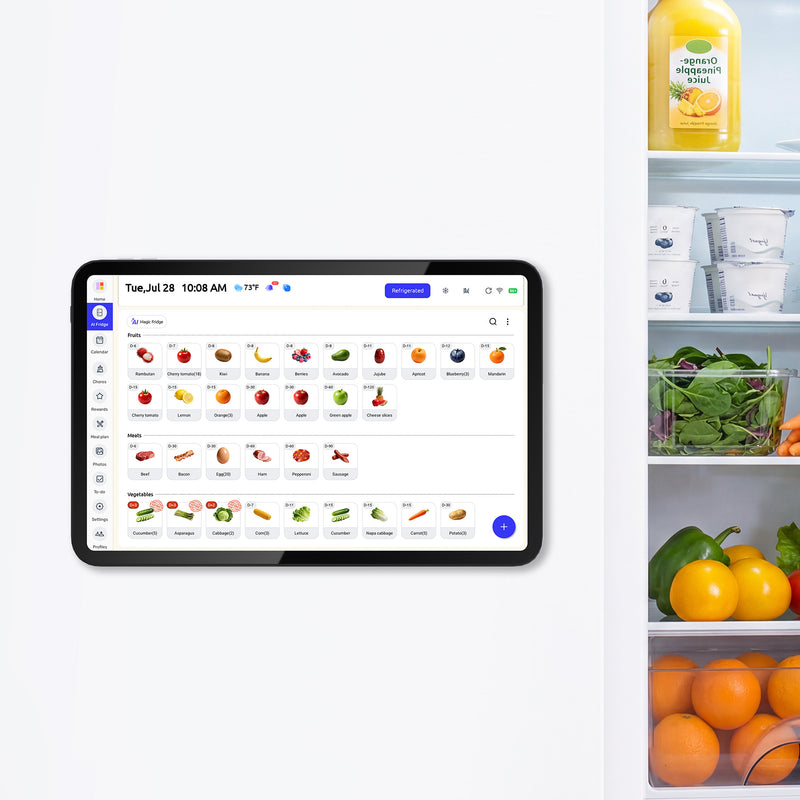
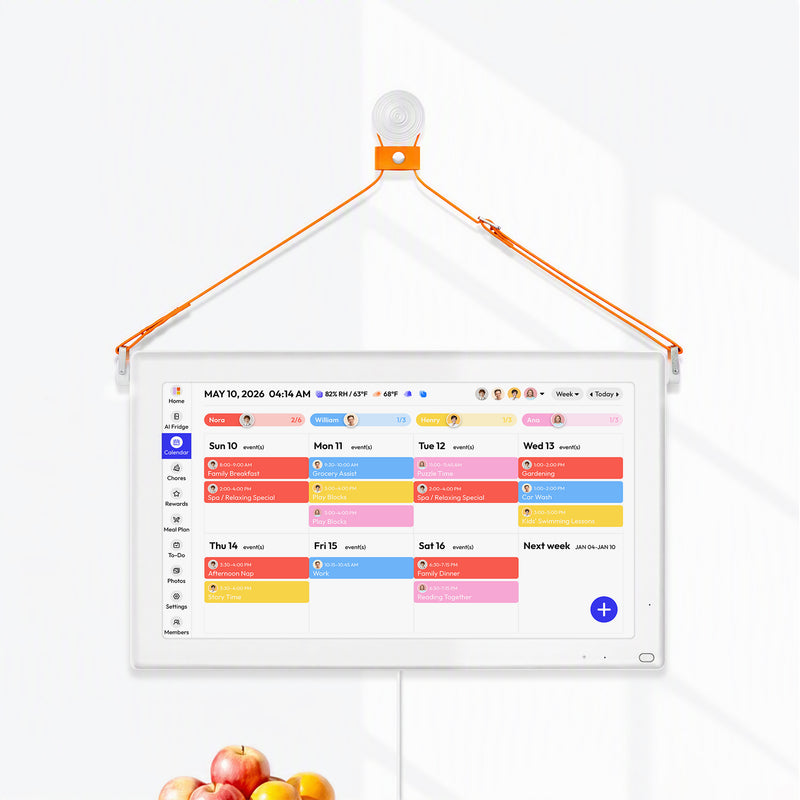
A home command center is the administrative hub for a household — somewhere between a bulletin board and a filing system, designed to catch the daily flow of papers, schedules, and small items that would otherwise colonize the kitchen counter. For a hybrid productivity system, it is the point where paper and digital tools converge in physical space. The principles established in earlier sections — paper for planning and depth, digital for coordination and automated reminders — need somewhere to land in your actual environment. Without that anchor, the system lives in your devices but not in your household.
Why Most Command Centers Fail
Most command centers devolve into clutter within three weeks — the same window in which behavioral research identifies the collapse point for most productivity systems. The causes are consistent: scope creep, poor placement, and no maintenance routine. Overloading a command center with components is the fastest way to ensure it becomes clutter you ignore. The same principle that makes a hybrid system work — a clear division of function — applies here directly.
Three components are non-negotiable: a calendar for shared ambient visibility; a paper management system with no more than three categories (action needed, upcoming, and reference); and a dedicated station for the items your household loses on a regular basis. Charging stations, elaborate cork boards, and dedicated homework stations have a documented failure rate — most households abandon them within a week. Keeping the setup lean is what keeps it functional.
Where to Put It
Three placement rules govern functional command centers: high traffic beats high visibility, proximity to natural drop zones matters more than aesthetics, and the setup must be accessible to everyone without requiring new behavior. The kitchen works precisely because it is already where household coordination happens. A command center near the kitchen counter intercepts existing behavior. One installed in a beautifully organized home office that only one person visits will be used by only one person.
Use temporary solutions — command hooks, clipboards, a dry-erase calendar — for at least two weeks before committing to anything permanent. A slightly imperfect system in the right location will outlast a perfectly designed one that nobody walks past. A weekly reset to update the calendar, clear the paper tray, and return items to their places is equally non-negotiable — without it, even a well-scoped setup degrades on the same timeline as every system before it.
Final Takeaway
The research converges on a clear conclusion: neither paper nor screens win outright, and the cost of treating them as interchangeable is measurable.
On the analog side, the numbers are consistent. Handwritten note-takers outperformed typists on subsequent assessments with an effect size of Hedges' g = 0.919 across 24 studies involving over 3,000 college students — all undergraduate samples in controlled or quasi-experimental settings. A network meta-analysis of 56 studies ranked paper as the most effective medium for reading comprehension across all digital device types, with paper outperforming digital devices by effect sizes of 0.35 to 0.48 specifically when scrolling was required. These are not marginal differences. Because handwriting forces paraphrasing, it activates prior knowledge and produces deeper levels of processing — the kind that produces understanding rather than just a record.
On the digital side, the performance gap is equally clear in a different task category. Digitally booked appointments carried a no-show rate of 1.8%, compared to 5.9% for offline bookings — a 70% relative reduction driven primarily by automated reminders, observed in a single ophthalmology practice. No paper planner produces outcomes like these for time-anchored commitments, because no paper planner sends a notification at 8:45 a.m. Paper encodes the appointment well. It does not retrieve it at the moment it becomes relevant.
The system-level data reinforces the case for combining both. Preliminary industry data suggest that the hybrid approach with the highest Day 90 retention rate — 74% — separated fast digital capture from deliberate paper-based reflection; this figure comes from an unverified industry source and should be read as directional rather than definitive. By contrast, 70% of users abandoned a single digital tool within the first 100 days — a figure drawn primarily from mental-health app studies. The hybrid did not just perform better — it held significantly longer.
The practical implication is straightforward. Assign paper to tasks where depth, comprehension, and focused thinking are the goal. Assign digital to tasks where coordination, automated follow-through, and retrieval at the right moment are what matter. Keep the boundary clear, keep each side to its minimum viable footprint, and review the system weekly to prevent the degradation that takes every unmanaged system back to baseline within three weeks. The goal was never to find the perfect system. It was to build one that fits how you actually work — and then stop looking for a better one.
References
- Rubinstein, J. S., Meyer, D. E., & Evans, J. E. (2001). Executive control of cognitive processes in task switching. Journal of Experimental Psychology: Human Perception and Performance, 27(4), 763–797. https://doi.org/10.1037/0096-1523.27.4.763
- Huang, Y., Yang, Z., & Morwitz, V. G. (2023). How using a paper versus mobile calendar influences everyday planning and plan fulfillment. Journal of Consumer Psychology, 33(1), 115–122. https://doi.org/10.1002/jcpy.1297
- Marano, G., Kotzalidis, G. D., Lisci, F. M., et al. (2025). The neuroscience behind writing: Handwriting vs. typing — who wins the battle? Life, 15(3), 345. https://doi.org/10.3390/life15030345
- Scoping review on digital tool abandonment (525,000+ participants): full citation details including author list, journal, volume, and DOI should be confirmed via the primary source at https://pmc.ncbi.nlm.nih.gov/articles/PMC11694054/ before citing in academic or professional contexts.
- Handwriting meta-analysis (24 studies, 3,000+ undergraduates, Hedges' g = 0.919): full citation details should be confirmed via the primary source at https://link.springer.com/article/10.1007/s10648-024-09914-w before citing in academic or professional contexts.
- Reading comprehension network meta-analysis (56 studies): full citation details should be confirmed via the primary source at https://link.springer.com/article/10.1007/s10639-025-13843-8 before citing in academic or professional contexts.
- Ophthalmology no-show rate study (~17,000 appointments): full citation details should be confirmed via the primary source at https://pmc.ncbi.nlm.nih.gov/articles/PMC12081397/ before citing in academic or professional contexts.
- Cognitive offloading and self-efficacy study: full citation details should be confirmed via the primary source at https://www.frontiersin.org/journals/psychology/articles/10.3389/fpsyg.2026.1781101/full before citing in academic or professional contexts.


