



If you've got a whiteboard stuck to your fridge or mounted on your kitchen wall, you already know how useful it can be — and how quickly it turns into a mess. This article breaks down what a kitchen whiteboard actually does well, where it falls short for busy families, and whether a digital fridge calendar can genuinely take its place.
What Do Families Actually Use a Kitchen Whiteboard For?

Before deciding whether to replace it, it helps to look at what the whiteboard is actually doing in your home.
1. Daily Schedules and Reminders
Most families use the whiteboard as a quick-glance spot for the week's schedule — after-school activities, appointments, work-from-home days, and one-off reminders like "dentist at 3pm." It works because it's visible, it's in a high-traffic area, and anyone can write on it.
2. Grocery Lists and Meal Notes
A corner of the whiteboard usually becomes the running grocery list. Someone finishes the milk, writes it down. Someone plans to make pasta Friday night, jots it under the list. It's low-friction and fast.
3. Chore Assignments for Kids
Many families draw out a simple chore chart — names across the top, days down the side, and a grid of checkboxes. It's one of the most common whiteboard uses in households with kids.
These three uses — keeping schedules, tracking groceries, and managing chores — are exactly what a digital fridge calendar is designed for. It’s no coincidence — this is how busy kitchens really stay organized.
Where Does a Kitchen Whiteboard Fall Short?
A whiteboard works fine in simple situations. But in households with multiple people, varying schedules, and life happening both inside and outside the home, it starts to show real limitations.
1. It Only Works When You're Standing in Front of It
This is the biggest limitation for modern families. If you're at work and need to check whether the kids have after-school practice today, the whiteboard can't help you. If your partner is grocery shopping and wants to see the list, they either took a photo earlier or they're guessing.
2. No Syncing — Updates Don't Reach Anyone on the Go
When something changes — a canceled lesson, a new appointment, a dinner plan — the person who wrote it on the whiteboard has to individually notify everyone else. There's no live update, no notification, no shared view. It's a one-location information system in a multi-location family.
3. No Reminders, No History, No Accountability
A whiteboard can't ping your kid at 4pm to remind them to take out the trash. It can't show you whether the chore was actually completed last Tuesday. Once you erase it, that information is gone. For households trying to build consistent routines, this matters.
4. Clutter and Readability Problems in Busy Households
After a week of multiple people adding notes, the whiteboard becomes hard to read. There's no color coding by person, no way to distinguish urgent from non-urgent, and no visual hierarchy. It's a flat surface with no structure.
What Can a Digital Fridge Calendar Do That a Whiteboard Can't?
This is where the comparison gets practical. A digital fridge calendar doesn't just digitize the whiteboard — it adds capabilities that a physical surface simply can't offer.
| Feature | Whiteboard | Digital Fridge Calendar |
| Real-time phone sync | ✗ | ✓ |
| Color coding by member | ✗ | ✓ |
| Interactive chore checklist | ✗ | ✓ |
| Rewards system for kids | ✗ | ✓ |
| Food expiration alerts | ✗ | ✓ |
| Meal planning + recipes | ✗ | ✓ |
| Weather display | ✗ | ✓ |
| Google/Outlook calendar sync | ✗ | ✓ |
1. Sync Instantly Across Everyone’s Phones
With a shared family calendar app, anyone can add or update events from their phone, and the changes appear immediately on the fridge screen. For example, if Mom adds a dentist appointment at 9 am or Dad updates dinner plans at 5 pm, everyone sees it right away — no need to run to the kitchen and write it on the board.
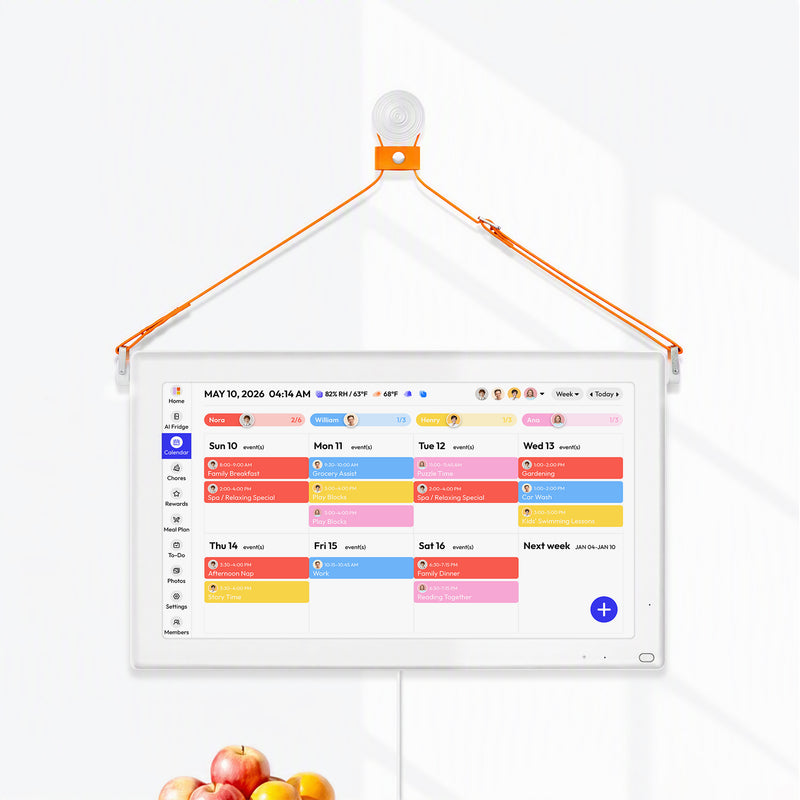
2. Color-Coded for Each Family Member
Instead of a messy board full of overlapping handwriting, each person gets their own color. Dad’s events might appear in blue, Mom’s in green, and the kids each have their own color. At a glance, you can tell who has soccer practice, piano lessons, or a work deadline coming up.
3. Chore Checklist Kids Can Interact With
Kids can mark chores as done right on the touchscreen. For example, finishing homework or taking out the trash earns them animated emoji rewards. This turns the chore chart from a boring list into a fun progress tracker that motivates kids instead of nagging them.
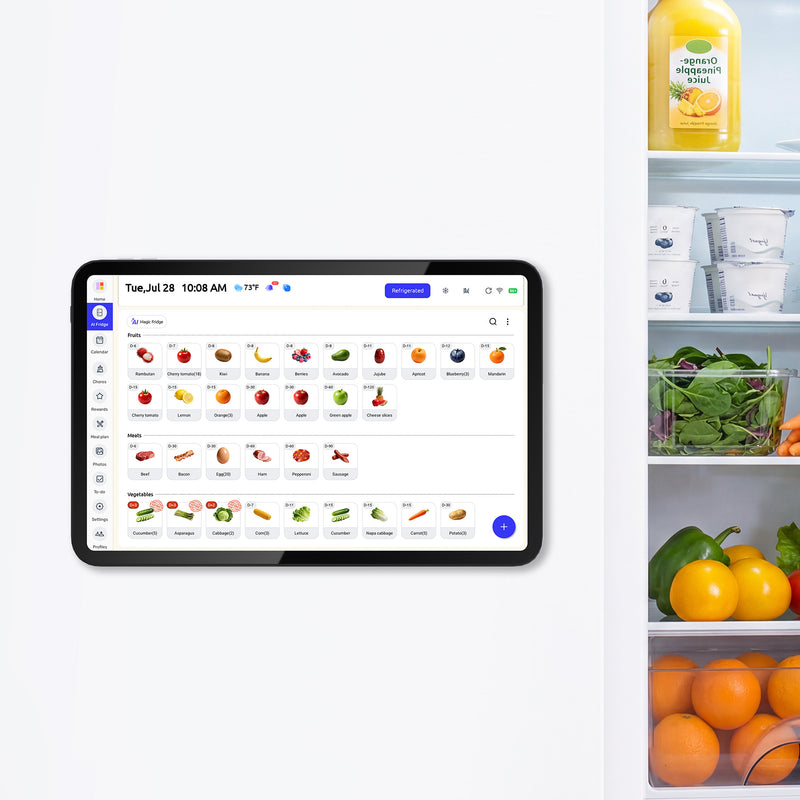
4. Smart Fridge Manager — Beyond Any Whiteboard
No whiteboard can do this: the Everblog FridgeCal Calendar tracks everything in your fridge, sends alerts when food is about to expire, and links ingredients to the Meal Planner. For example, if you have chicken, bell peppers, and rice, it can suggest a stir-fry recipe, show calories, and even link to a YouTube tutorial. It’s like having a personal kitchen assistant.
5. All-in-One View: Groceries, Meals, and Weather
The touchscreen shows grocery lists, meal plans, and the weather in one glance. For instance, you can see tomorrow’s lunch plan, check what’s running low in the pantry, and see if it’s going to rain — all without flipping between apps or scribbling on a whiteboard.
When Does a Whiteboard Still Make Sense?
Before you toss your old whiteboard, let’s be real — it’s not useless in every situation! Sometimes a simple board can still do the job better than a fancy digital calendar. It all depends on your household, your internet setup, and how many schedules you’re juggling.
No WiFi or Tech-Resistant Households
A digital fridge calendar requires Wi-Fi to sync calendars, get weather updates, and access smart features. In homes without reliable internet — or with family members who aren't comfortable with touchscreen devices — a whiteboard remains a perfectly functional tool.
Very Simple, Single-Person or Couple Households
If you live alone or with one other person and your scheduling needs are minimal, a whiteboard or even a paper planner may be more than enough. The full feature set of a digital fridge calendar is most valuable when there are multiple people, multiple schedules, and multiple moving parts to coordinate.
As a Secondary Surface Alongside a Digital Fridge Calendar
Some families find value in keeping a small whiteboard for truly spontaneous, temporary notes — a phone number jotted quickly, a quick reminder for a contractor visiting that day. Used this way, the whiteboard becomes a scratch pad rather than the household's main communication system.
How to Transition from a Kitchen Whiteboard to a Digital Fridge Calendar
Thinking about swapping your kitchen whiteboard for a digital fridge calendar? It might sound like a big change but it does not have to be tricky! Start with the things you actually use your whiteboard for and set up your calendar so it works with your daily routine.
1. Take It Step by Step, Don’t Rush
Switching from a whiteboard to a digital fridge calendar works best when you do it gradually. Trying to move everything at once can overwhelm the family and make the new system feel complicated.
Try this: Instead of moving both chores and schedules at once, start with just the grocery list for the first week. This lets everyone get used to adding items on the touchscreen without feeling lost.
2. Track What You Actually Use Your Whiteboard For
Before erasing anything, spend a week observing what’s really on your whiteboard.
- Are you writing schedules, grocery items, or chore assignments?
- Do you add recurring reminders like “trash day” or “soccer practice”?
- Are there one-off notes, such as “call the plumber”?
3. Sync Calendars and Personalize Colors
Get everyone on board by making the calendar feel personal:
- Connect Google or Outlook calendars so events appear automatically.
- Assign each family member a color (e.g., blue for Dad, green for Mom, red for the kids).
- Color coding makes it easy to see at a glance who has what on their schedule.
For instance: If Mom has a dentist appointment at 3 pm and Dad has a work meeting at the same time, their colors help kids immediately know who’s busy without asking.
4. Move Grocery Lists and Chores First
Focus on the parts of the whiteboard your family uses most:
- Set up Custom Lists for grocery items.
- Create an interactive Chore Chart for your kids, where they can check off tasks on the screen.
Instead of writing “Take out trash” on the whiteboard, your child taps it on the touchscreen. When completed, they get an animated star or emoji as a reward. This makes chores feel like a game and keeps track automatically.
5. Find the Best Spot in Your Kitchen
Placement affects how often the calendar is used.
- Ideal spots: fridge door, kitchen entrance, or a central wall at eye level.
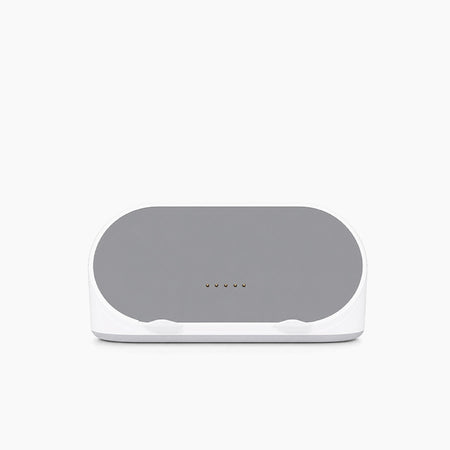
- Built-in magnetic mount holds the calendar securely without drilling.
- For glass or non-magnetic doors, use included magnetic stickers.
- Grip strength is 33–40 lbs, over five times the device weight, so it won’t slip.
Place it on the fridge near the snack shelf. Kids can quickly check the chores or see what’s for dinner while grabbing a snack, making it part of their routine.
With the calendar in the right spot and a little personal touch, it does more than replace a whiteboard. It becomes the go-to place in your kitchen that keeps everyone organized, in the loop, and even a little motivated.
Make the Switch to a Digital Fridge Calendar Your Kitchen Deserves

A whiteboard served its purpose — but for a household with multiple people, changing schedules, and real coordination needs, it runs out of road fast. A digital fridge calendar covers everything a whiteboard does, then adds real-time syncing, expiration alerts, interactive chore tracking, meal planning, and more. If your current system involves a lot of "did you see what I wrote on the board?" — it's probably time to upgrade.
Digital Fridge Calendar FAQs
Q1: Can a Digital Fridge Calendar Show a Grocery List Like a Whiteboard Does?
Yes. Digital fridge calendars include custom list features where you can build and update a grocery list directly on screen. Unlike a whiteboard, the list is also accessible from your phone, so you can check it while you're actually at the store. Family members can add items remotely, meaning the list updates in real time without anyone having to be home.
Q2: Do Digital Fridge Calendars Work Without WiFi?
Not always. Core display features like showing your calendar entries may still function offline, but live syncing, weather updates, recipe recommendations, and app-based updates all require an active Wi-Fi connection. If your home has reliable internet, this isn't a concern. For households with spotty connectivity, it's worth factoring that into the decision before purchasing.
Q3: Can We Place a Fridge Calendar in the Kitchen?
Absolutely. The kitchen — and specifically the fridge — is the intended placement for a digital fridge calendar. It's where families already gather, check schedules, and plan meals, which is exactly why fridge-mounted placement makes it useful rather than easy to ignore. The Everblog FridgeCal Calendar is specifically designed to mount directly onto your refrigerator door.
Q4: Where to Place a Fridge Calendar as per Feng Shui?
It depends on your layout, but Feng Shui principles generally favor placing functional items in the command position — where you can see the entrance without being directly in line with the door. In kitchen terms, this often means the side wall of the fridge or a spot with clear sightlines to the kitchen entrance. Avoid placing it in cluttered corners or spots that disrupt natural flow through the space.
Q5: Is a Digital Fridge Calendar Hard to Set Up for Non-Tech-Savvy Families?
No. Most digital fridge calendars, including the Everblog FridgeCal Calendar, are designed for everyday household use — not tech enthusiasts. Setup typically involves connecting to Wi-Fi, signing into a Google or Outlook account to sync the calendar, and assigning colors to family members. The touchscreen interface is intuitive, and features like the chore chart and grocery list don't require any technical background to use.


