

If you're trying to cut down on food waste or just stop buying things you already have, you've probably looked at both grocery list apps and smart fridge tracking. They sound similar, but they solve different problems. Here's a clear breakdown of how each one works, where they fall short, and which one actually fits your household better.

Side-by-Side Comparison
| Feature | Grocery List Apps | Smart Fridge Tracking |
| Primary focus | What to buy | What you already have |
| Best used | At the store | At home, before and after shopping |
| Expiration alerts | Rarely | Yes — with advance notice |
| Tracks fridge inventory | No | Yes |
| Prevents duplicate purchases | Limited | Yes — via real-time mobile sync |
| Reduces food waste | Indirectly | Directly |
| Connects to meal planning | No | Yes |
| AI recipe suggestions | No | Yes (select systems) |
| Family sharing | Yes | Yes |
| Mobile access while shopping | Yes | Yes |
| Calendar / schedule integration | No | Yes (select systems) |
| Organizes by shelf / category | No | Yes |
| Setup effort | Low | Moderate |
| Typical cost | Free or low-cost | Hardware or subscription fee |
How Do Grocery List Apps Work?

Grocery list apps are built around the shopping experience. You open the app, add items you need, and check them off as you go through the store. Most of them keep it simple, but the better ones add a few extra layers.
Common features include:
- Shared lists: Multiple family members can add to the same list in real time, so nothing gets missed before someone heads to the store.
- Category sorting: Items get grouped by aisle or food type, which makes store trips faster and less frustrating.
- Recurring items: You can save staples like milk, eggs, or bread so they show up automatically each week.
- Recipe import: Some apps let you pull ingredients directly from a recipe and add them to your list in one tap.
The limitation is that grocery list apps don't know what you already have at home. You still have to mentally track your fridge and pantry before making the list — and that's exactly where things go wrong.
What Is Smart Fridge Tracking?

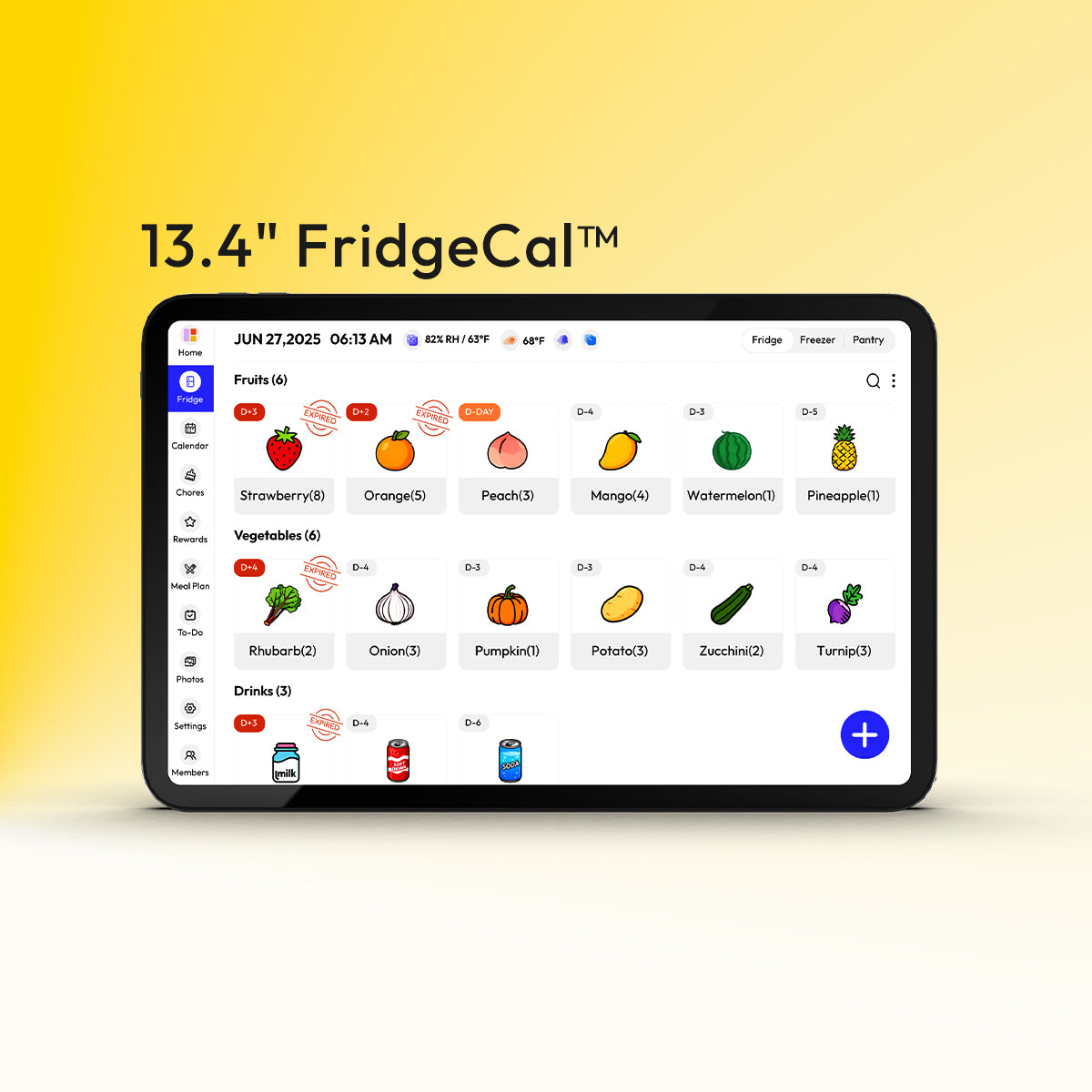
Smart fridge tracking is a home inventory system. Instead of focusing on what you need to buy, it focuses on what you already have — and whether it's still good. The Everblog FridgeCal Calendar takes this idea and runs with it — smart fridge tracking, family calendar, and meal planning all on a screen that sticks right to your fridge door.
Here's how it typically works:
- You always know what's in your fridge: When you get home from the store, you add items to the system — what you bought, how many, and where it's stored (fridge, freezer, or pantry). A digital calendar like Everblog FridgeCal Calendar keeps this from feeling like a chore by offering 15 preset food categories, so you're just tapping to sort rather than typing everything from scratch.
- Nothing expires without warning: The system tracks use-by dates and gives you a heads-up before something goes bad — usually a couple of days in advance, so you actually have time to use it. A smart fridge tracking system sends these reminders both on the fridge screen and straight to your phone, so you won't miss them even when you're out.
- No more guessing at the store: Ever stood in the grocery aisle wondering if you already have butter at home? With a digital fridge calendar syncing your inventory in real time, you can just pull out your phone, check, and leave it on the shelf if you already have it at home.
- See what your fridge is actually made of: Some systems show a breakdown of what's in your fridge by category — fruits, proteins, snacks — which makes it easier to spot if things are getting a little unbalanced. A digital calendar can organize everything by category and shelf location right on the fridge screen, so anyone in the family can see what's there without even opening the door.
Once you get into the habit, smart fridge tracking starts to feel less like a system and more like a second brain for your kitchen. You stop forgetting what you have, stop throwing out food that slipped to the back of the shelf, and stop making that extra store run for something you already bought last week. It quietly handles the stuff that usually falls through the cracks.
Smart Fridge Tracking vs Grocery Apps: Which One Saves More Time?
Time loss in a household adds up fast — an extra store run here, ten minutes figuring out dinner there, a text back and forth trying to confirm what's already in the fridge. The right tool depends on where that time is actually going.
When a Grocery List App Saves You More Time
1. When Someone Comes Back Without Half the List
A shared grocery list lets anyone in the family add items the moment they notice something is running low. Whoever is at the store sees the current, complete list — no outdated texts, no guessing. One trip gets the job done instead of two.
2. When the Store Takes Twice as Long as It Should
Without a list, most people walk through the store from memory — going back to aisles they already passed, standing still trying to remember what they needed. A list organized by food category keeps you moving through the store in order, and a trip that usually takes 45 minutes becomes noticeably shorter.
3. When Figuring Out What to Buy Takes Longer Than Cooking
Some grocery apps let you import a recipe and generate the ingredient list automatically. You remove what you already have at home and head to the store with a ready list — the whole process takes a couple of minutes instead of going back and forth between the recipe and the fridge.
If most of your time is lost during the shopping process, a grocery list app is the more practical tool.
When Smart Fridge Tracking Saves You More Time
Smart fridge tracking works differently from a grocery app — instead of helping you buy more efficiently, it helps you make better use of what you already have. For families, the Everblog FridgeCal Calendar puts that into practice by keeping the fridge inventory, family schedule, and meal planning all visible on the same screen.
1. When You Stare at the Fridge and Still Can't Decide
It's late afternoon and you need to decide what to make for dinner. You open the fridge, look around, and can't figure out what to cook with what's actually in there — especially if some things are close to expiring.
- See everything at once: Smart fridge tracking shows your full inventory organized by category and shelf location, so you can check what you have without opening the fridge and standing there.
- Cook what needs to be used: You can see what needs to be used soon and plan dinner around it, rather than defaulting to takeout or a last-minute store run.
- Shared by the whole family: On a smart fridge calendar like the Everblog FridgeCal Calendar, the fridge inventory is displayed directly on your fridge screen — anyone in the household can check it, not just the person who last went shopping.
- Dinner sorted in seconds: The Everblog FridgeCal Calendar's AI recipe feature lets you select the ingredients you already have and suggests recipes to match — with YouTube videos to walk you through the cooking, right there on the fridge screen. You go from "I have no idea what to make" to dinner on the table without leaving the kitchen.
2. When the Whole Family Needs to Stay on the Same Page
Managing a family schedule means a lot of moving parts — school pickups, after-school activities, work commitments, and everything in between. Keeping track of it all by memory or scattered texts is where time quietly disappears.
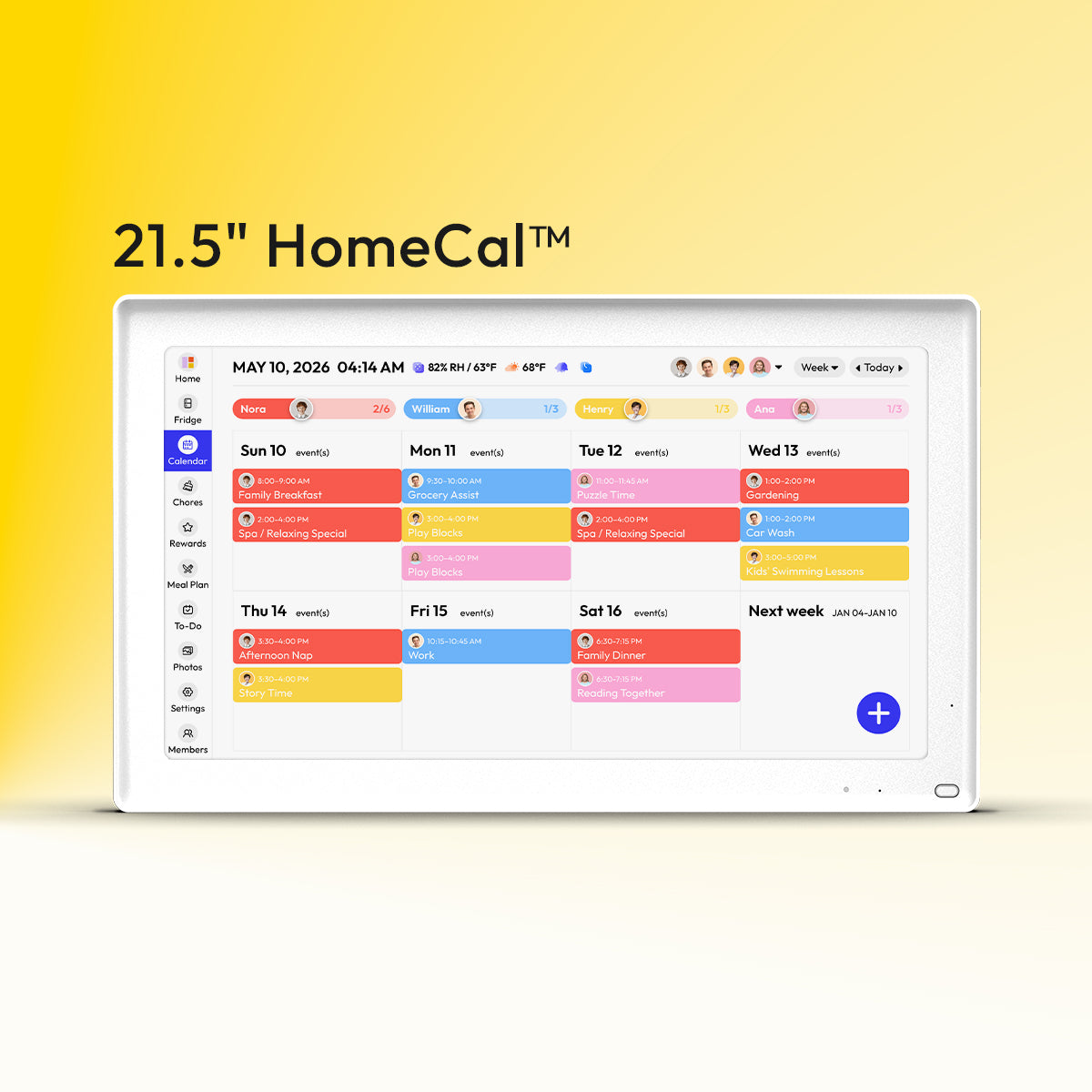
- One place for everything: The Everblog FridgeCal Calendar syncs with Google and Outlook, so the whole family's schedule is visible in one place — day, week, or month view, right on the fridge screen.
- Know whose day is packed: Each family member can be assigned a unique color, so anyone can see at a glance whose day is packed and whose is free.
- Always up to date: Updates made on the go sync instantly, so there's no back-and-forth to confirm plans or double-check who's doing what.
3. When Everyone's Asking What's in the Fridge at 7am
On busy school mornings, family members need quick answers — is there yogurt, is there enough bread, what's available for breakfast.
- No more asking around: Instead of opening the fridge or asking the person who did the last grocery run, anyone can check the shared inventory on the fridge screen in a few seconds.
- Kids can check for themselves: With the Everblog FridgeCal Calendar, items are organized by shelf and category, so kids can find the answer themselves without needing help.
- Keep the morning moving: One quick glance at the screen answers the question before it turns into a five-minute conversation.
If most of your time is lost at home — deciding what to cook, checking what you have, or keeping the family in sync — smart fridge tracking is the more practical tool.
Smart Fridge Tracking vs Grocery Apps: Which One Reduces Food Waste More?
Smart fridge tracking is the more effective tool for reducing food waste, and the reason is straightforward: grocery list apps have no visibility into your fridge. They can't tell you what's already there, what's close to expiring, or what's been sitting untouched for a week. The waste happens without any warning — and by the time you notice, it's too late.
Why Grocery List Apps Don't Prevent Food Waste
Grocery list apps are designed for shopping, not inventory. Once the items are in your fridge, the app has no further role. That means:
- No expiration alerts: The app doesn't know you bought strawberries four days ago or that the chicken in the back of the fridge expires tomorrow.
- No visibility into what you already have: If something gets pushed to the back of the fridge or forgotten in the freezer, the app won't surface it — you have to find it yourself.
- No connection to meal planning: There's nothing in a grocery list app that prompts you to use what's already there before buying more of the same thing.
The result is that food gets bought, stored, forgotten, and thrown away — and the grocery list app plays no part in stopping that cycle.
How Smart Fridge Tracking Reduces Waste Directly
Smart fridge tracking works at the inventory level, which is where food waste actually starts.
1. The Expiring Item You Would Have Missed
You bought a bag of salad greens at the start of the week. By Wednesday, it's been pushed behind other containers and completely forgotten. Without a tracking system, you find it Friday and throw it out.
- Smart fridge tracking logs the item and its expiration date when you add it.
- You get an alert a couple of days before it expires — enough time to use it in a meal rather than discover it too late.
- The Everblog FridgeCal Calendar sends these reminders on the device screen and through the mobile app, so the alert reaches you wherever you are.
2. That Extra One You Didn't Need
You're at the store and can't remember if you have a certain item at home. You pick one up to be safe, get home, and find you already had it.
- A grocery list app offers limited help here — if your list is up to date, it can prevent you from adding something you planned to buy, but it cannot confirm what's already in your fridge.
- Smart fridge tracking syncs your home inventory to your phone, so the person at the store always has an accurate, up-to-date picture of what's already at home — no guesswork, no duplicate purchases.
- The Everblog FridgeCal Calendar updates in real time, so whoever is at the store can pull up the current inventory on their phone and confirm what's already at home.
When items stack up faster than they get used, they expire before anyone gets to them — and that's where the waste actually starts.
3. The Fridge Nobody Fully Knows
In most households, one person does the majority of the shopping and knows what's in the fridge. Everyone else guesses — or just opens it and stares.
- A shared fridge inventory on a smart fridge calendar makes the full contents visible to everyone in the household at a glance.
- If your partner knows there's leftover cooked chicken that needs to be used, they can factor it into dinner without having to ask.
- With the Everblog FridgeCal Calendar, items are organized by category and shelf location directly on the fridge screen, so the information is available to the whole family, not just one person.
A smart fridge calendar with built-in fridge tracking closes the gap between what's in your fridge and what gets planned for meals. Instead of deciding what to cook from scratch each week, you can see what's already there — especially what's expiring soon — and build your meals around it. You use what you have, reduce what gets thrown away, and only add to your grocery list what's genuinely missing.
Smart Fridge Tracking vs Grocery Apps: Who Should Choose What?
Choose a grocery list app if:
- You mainly want help organizing your shopping trips and keeping the list shared across family members.
- You're looking for a free or low-cost tool with minimal setup.
- Your household already has a good handle on what's in the fridge and just needs help at the store.
- You're looking for a free or low-cost solution — most grocery list apps are free or available for a small one-time fee.
Choose smart fridge tracking if:
- You frequently throw away food because it expires before you use it.
- Your fridge is hard to keep track of — lots of people, lots of items, things getting pushed to the back.
- You want a system that connects inventory, meal planning, and expiration alerts in one place.
- You're already considering a smart fridge calendar for home organization.
Use both if:
- You want to close the full loop: know what you have, plan meals around it, and buy only what you actually need.
The right choice is the one that addresses your biggest pain point first. Start there, build the habit, and expand from there if needed. A well-organized kitchen rarely comes from one tool alone — but it always starts with solving one problem at a time.
Smart Fridge Tracking vs Grocery List Apps FAQs
Q1: Is fridge tracking better than grocery apps?
Not always — it depends on what problem you're trying to solve. Grocery list apps are better for organizing your shopping trips. Smart fridge tracking is better for reducing food waste and knowing what you already have at home. For most families, the two work best together rather than as replacements for each other.
Q2: Can a smart fridge calendar replace grocery apps?
Not entirely. A smart fridge calendar with built-in fridge tracking handles inventory and expiration alerts well, and many include basic list features for groceries. But they don't replicate the store-focused experience of a dedicated grocery app — things like aisle sorting, retailer integration, or one-tap item reordering. Think of it as a complement, not a replacement.
Q3: How does fridge tracking connect to meal planning?
Directly. When you can see what's in your fridge and what's about to expire, you can plan meals around what you already have instead of starting from scratch. A smart fridge calendar with built-in fridge tracking — like the Everblog FridgeCal Calendar — links inventory visibility to a meal planner on the same screen, so the connection between what's in the fridge and what's for dinner becomes much more natural.
Q4: Do grocery list apps track expiration dates?
Rarely. Most standard grocery list apps don't track expiration dates. A small number of hybrid pantry apps include basic expiration tracking, but it's not a standard feature of shopping-focused list apps. They're designed for the shopping experience, not home inventory management. Expiration tracking is a core feature of smart fridge tracking systems, which is one of the main reasons the two tools serve different needs.
Q5: Is smart fridge tracking hard to set up?
Not really. There's a bit more to set up compared to a grocery list app. You need to log your existing inventory when you start, and add new items each time you shop. Once you're in the habit, it becomes quick.
Start Reducing Food Waste with Smart Fridge Tracking
If you're spending money on groceries you're not using, a grocery list app alone won't fix it. A smart fridge calendar like the Everblog FridgeCal Calendar gives you visibility into what you actually have, alerts you before food expires, and connects your inventory directly to meal planning — all on the screen mounted right on your fridge. Start with whichever gap costs you the most — wasted food or disorganized shopping — and build from there.


