






A family fridge calendar with meal planning works best when the calendar shapes dinner before recipes shape the grocery list. Start with who will be home, when they will arrive, how much cooking attention is available, and which food should be used. Then choose realistic meals and buy only the missing ingredients.
That order solves a common planning mistake: selecting seven appealing dinners for an imaginary week. Tuesday's elaborate recipe fails when practice ends at 7:15. Friday's fresh ingredients go unused when everyone eats elsewhere. A schedule-first plan accepts those constraints before money and effort are committed.
Before Choosing Recipes Check Your Family’s Week
The four-step order keeps the meal plan connected to real time and existing food. Each step narrows the next decision.
|
Input |
Question to answer |
Minimum information |
Decision it changes |
|
Calendar |
Who is home and when? |
Arrival times, practices, late work, travel |
How much time and coordination dinner can require |
|
Food on hand |
What should or can be used? |
Leftovers, produce, proteins, staples |
Which meals get priority |
|
Meal choice |
What fits the available window? |
Active time, total time, skill, cleanup |
Main meal and backup |
|
Grocery gaps |
What is missing for the chosen plan? |
Required amount minus usable amount |
Final shared shopping list |
The U.S. Environmental Protection Agency recommends checking the refrigerator, freezer, and pantry, planning weekly meals, and building a list around meals that will actually be eaten at home. A schedule-first workflow adds one question before recipe selection: will the household have the time and people needed to make that meal happen?
How Much Time Can You Actually Spend Cooking?
A “30-minute meal” may require 25 minutes of continuous chopping and stirring. A one-hour tray bake may need only ten minutes of active work. On a night with homework support, calls, or staggered arrivals, active attention is often the scarcer resource.
Who Will Be Home for Dinner and When?
Record who will actually eat at home. If one parent is traveling and a child eats after practice, the family may need three portions at two different times rather than five portions at once. That affects recipe choice, holding quality, and quantity.
Start With Ingredients You Already Have
Open spinach, cooked rice, and a freezer protein narrow the choices in a helpful way. A fast fridge organization system can make that scan easier, but the plan still needs a person to decide what is usable and appropriate.
Choose Meals That Fit Busy Quiet and Low Energy Evenings
The Schedule-First Meal Matrix sorts evenings by household capacity rather than cuisine. It makes “what should we cook?” a smaller, answerable question.
|
Night type |
Available capacity |
Best meal category |
Examples |
Backup |
|
Open night |
45–60 minutes and shared help |
Cook and prepare extra |
Roast chicken, curry, baked pasta |
Simplified skillet version |
|
Split-shift night |
People arrive at different times |
Holds or reheats well |
Soup, grain bowls, chili |
Sandwiches and fruit |
|
Practice night |
Under 20 active minutes |
Prepped, assembled, or slow-cooked |
Tacos, sheet-pan meal, slow-cooker stew |
Eggs and toast |
|
Late-work night |
One adult carrying dinner |
Low-attention familiar meal |
Pasta, rotisserie-chicken bowls |
Freezer meal |
|
Recovery night |
Low energy or no reliable window |
Planned leftovers or takeout |
Leftover buffet |
Shelf-stable emergency meal |
|
Prep night |
20–30 spare minutes after dinner |
Meal plus component prep |
Stir-fry and chopped vegetables |
Prep only one ingredient |
This matrix is an editorial framework, not a nutritional prescription. Families should adapt it for dietary needs, cooking ability, budget, and food-safety requirements.
Use a Quieter Evening to Prepare for a Busy One
If Monday is calm, cook extra rice or roast additional vegetables for Wednesday. Do not add prep merely because time exists; prepare a component with a named destination in the plan. Sunday vegetable prep can follow the same rule: wash or cut only what will save meaningful work later.
What Can You Serve When Everyone Eats at Different Times?
Choose food that can be portioned and reheated safely without losing its appeal. Grain bowls, soup, and chili generally tolerate staggered service better than fried or delicately dressed food. Record storage and reheating instructions when older children will serve themselves.
Plan an Easy Dinner for Nights When Nobody Wants to Cook
Leftovers, a freezer meal, or planned takeout is not evidence that meal planning failed. It is capacity management. The failure is pretending every night has the same resources.
A Seven Day Meal Plan for Practice Nights Late Meetings and Family Time
The following week is illustrative. It shows how calendar constraints, usable food, and preparation notes work together.
|
Day |
Schedule constraint |
Food to use |
Realistic meal |
Preparation and backup |
|
Monday |
Everyone home by 5:30 |
Chicken, carrots |
Roast chicken, carrots, rice |
Cook extra rice for Friday |
|
Tuesday |
Practice 5:00–7:00 |
Open spinach |
Pasta with spinach and beans |
Sauce made Monday; backup is eggs |
|
Wednesday |
Parent meeting until 6:30 |
Chicken leftovers |
Chicken grain bowls |
Components portioned Tuesday |
|
Thursday |
Everyone home, children can help |
Tortillas, beans |
Build-your-own tacos |
Chop toppings after school |
|
Friday |
Staggered arrivals |
Extra rice, vegetables |
Vegetable fried rice |
Holds for late arrival; freezer dumplings backup |
|
Saturday |
Afternoon activities, evening open |
Freezer fish |
Baked fish, potatoes, salad |
Move fish to refrigerator Friday |
|
Sunday |
Weekly reset and light prep |
Remaining produce |
Soup and bread |
Freeze extra soup for next week |
Monday is the production night because the calendar permits it. Tuesday consumes spinach that should be used and relies on sauce prepared earlier. Wednesday converts leftovers into a different format. Friday uses the reserved rice. Saturday's critical action is not dinner itself; it is thawing the fish safely at the right time.

What Needs Thawing or Preparing Before Dinner Day?
“Fish Saturday” is incomplete if the fish remains frozen until 5:00 p.m. Friday should contain the thawing reminder. Similar upstream tasks include soaking beans, moving a freezer meal, packing a slow cooker, or asking a teenager to start rice.
Name the dinner owner
The person who selects a meal is not automatically the person cooking it. Assign the owner in the shared plan and identify any child-appropriate tasks. The aim is to make labor visible without turning the meal plan into a minute-by-minute project schedule.
Place the backup beside the main plan
A backup hidden in someone's memory is not operational. “Pasta with spinach; backup eggs and toast” lets another adult change course without asking permission when practice runs late.
Build the Grocery List From Confirmed Meals
Write the list only after the household agrees that the meals fit the week. Start with required quantities, subtract usable food, and add the remaining amount.
For Monday's chicken dinner, an existing chicken and carrots mean the list may need only rice. Tuesday's pasta might require pasta and beans but not spinach. The inventory prevents duplicates only if the family checks it and reserves ingredients for their assigned meals.
Shop for the plan, not for possible inspiration
“Maybe we'll make lasagna” is not a reason to buy a complete second dinner. If the family wants flexibility, select one versatile backup kit such as pasta and shelf-stable sauce, not several unassigned sets of perishables.
Put quantities and purpose on ambiguous items
“Yogurt” can mean one breakfast cup or a large container for five lunches. Write “five lunch yogurts” or “32-ounce plain yogurt for breakfasts.” A well-designed shared grocery-list process helps two shoppers interpret the same requirement.
Keep meal ingredients and household staples distinct
Meal gaps come directly from the plan. Staples such as coffee or dish soap follow a replenishment rule. Separating the two makes it easier to remove meal ingredients when plans change without deleting genuine household needs.
When the Week Changes, Recalculate the Smallest Affected Area
A schedule change should trigger a focused review, not a complete restart. Identify the affected dinner, ingredients, prep task, and shopping-list items.
|
Change |
Immediate meal response |
Inventory or grocery response |
New owner or deadline |
|
Tuesday practice moves one hour later |
Use eggs-and-toast backup |
Save spinach for Wednesday bowls; remove no items |
Jordan starts dinner at 7:20 |
|
Wednesday meeting is canceled |
Cook bowls together earlier |
No list change |
Alex cooks at 5:45 |
|
Thursday guest joins |
Add two taco portions |
Add tortillas and one can of beans |
Shopper claims additions by noon |
|
Friday becomes restaurant night |
Move fried rice to Sunday lunch |
Do not buy optional garnish |
Mark rice reserved |
|
Saturday activity runs late |
Use freezer dumplings |
Keep fish safely chilled for Sunday |
Move soup plan to next week |
This Plan-Change Protocol preserves useful work. It also prevents an abandoned meal from continuing to generate grocery purchases.
Recheck perishables first
When a meal moves, decide whether fresh ingredients can move with it. A shelf-stable item can wait. Fresh fish, thawed meat, cut produce, or opened dairy may require a different response based on authoritative storage guidance.
Change ownership when capacity changes
If the original cook is now driving to practice, do not leave the meal assigned to that person. Name a new owner or activate the backup. A visible plan should reveal that handoff, not hide it in a message thread.
ALT:everblog fridgecal displaying weekly dinner plans, family schedules, and grocery lists
When Can a Fridge Calendar Help With Family Dinners?
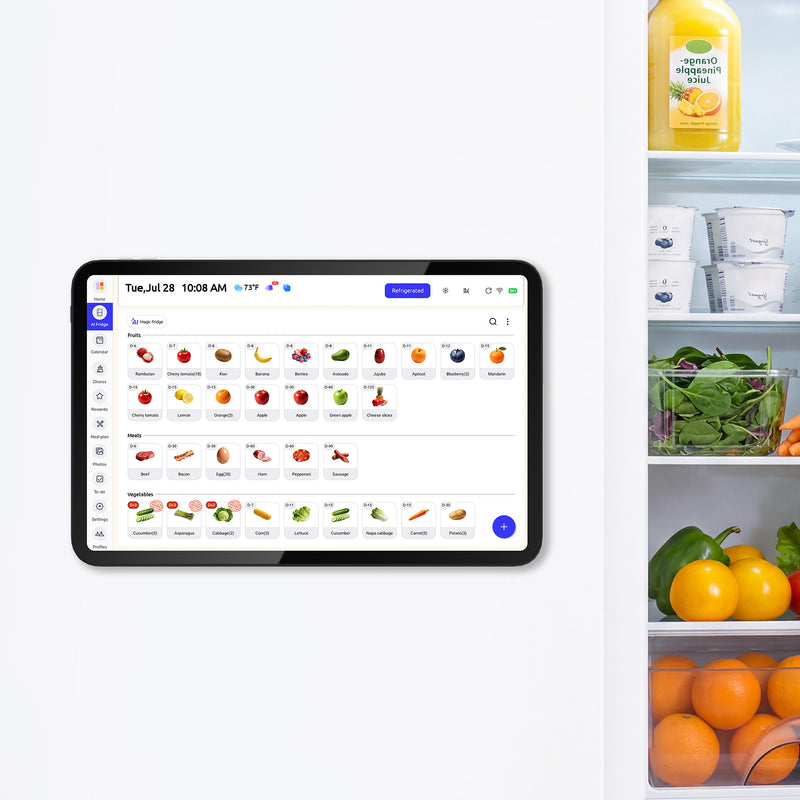
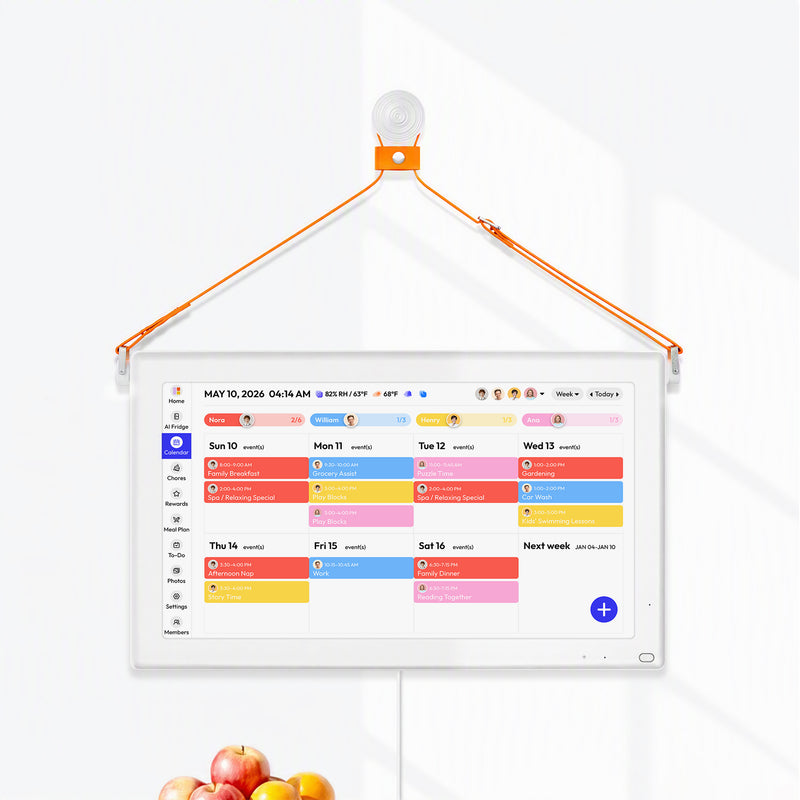
A fridge-side planning surface helps when the household repeatedly needs to see schedule constraints, meals, inventory, and shopping needs together. It is an execution aid, not an automatic meal-planning authority.
A shared kitchen display for schedules and meal planning brings connected calendars, meal planning, recipe suggestions, shopping lists, and food inventory together on a rechargeable, magnetically mounted touchscreen. Family members can check or update plans through the companion app away from the kitchen. This supports the four-step workflow, but a changed schedule still calls for someone to review dinner choices, preparation tasks, and grocery quantities rather than assuming they adjust automatically.
There are practical tradeoffs. A dedicated display needs charging, Wi-Fi for connected functions, suitable mounting, account setup, and routine data maintenance. Families should test supported calendar accounts, permissions, phone access, and what happens when connectivity is unavailable. A magnetic whiteboard may be better when plans change rarely. A shared calendar plus a paper meal list can work well when everyone follows the same routine. A phone-only system may be enough if all household members check it without reminders.
Plan Next Week’s Dinners in One Short Family Check In
The routine should produce a usable week, not a perfect menu.
- Scan the calendar and label each night by capacity.
- Check the refrigerator, freezer, and pantry for “use first” food.
- Choose meals from the matrix and add one backup for fragile nights.
- Assign the cook and place preparation on the correct day.
- Calculate grocery gaps and publish one shared list.
- Recheck the plan after any major schedule change.
A broader guide to meal planning for busy families can help with batch cooking and repeatable routines. Keep this weekly process focused on fit.
Frequently Asked Questions
Do You Need to Cook Dinner Every Night?
No. Plan for the nights the household will eat at home and include leftovers, freezer meals, or planned takeout when capacity is low.
What Should You Check on the Calendar Before Planning Meals?
Arrival times, attendance, transport duties, late work, practices, travel, and preparation deadlines matter most. Private appointment details usually do not.
How Many Backup Dinners Should You Keep Ready?
One or two familiar, low-effort options are usually easier to maintain than a large emergency menu. Choose foods the household will actually eat and replenish them after use.
Should You Choose Recipes Before Checking the Week’s Schedule?
The schedule should come first. It defines the available time, attention, and number of diners. Then choose recipes that fit those conditions.
Can a digital calendar adjust the meal plan when an event changes?
Some tools may place calendars and meals in the same system, but families should not assume automatic replanning. Review the affected meal, prep, inventory, and list entries after a meaningful change.


