




Quick Answer
If you're asking, “How can I reduce food waste at home?”, begin with four repeatable actions: see what you already have, plan around food that needs attention, buy only the gaps, and use or freeze food before it is forgotten. Start with one weekly fridge check, one visible use-first zone, and one flexible meal. A tracking tool can help, but only if the family keeps it current.
Picture a normal grocery day: new yogurt goes in front of older cups, spinach disappears behind a produce bin, and an unlabeled leftover container reaches the back shelf. The household intended to eat everything. The missing piece was a shared sequence from storage to meal to shopping decision.
The See, Plan, Buy, Use loop below turns familiar tips into a small operating system. It works with paper labels and a grocery list; no new hardware is required.
How Much Food Does Your Family Throw Away Each Week?
National estimates show the scale, but a seven-day household audit reveals which decisions your family can change. The purpose is diagnosis, not guilt.
The EPA's 2025 estimate of the cost of consumer food waste puts the average at $728 per U.S. consumer per year. EPA expresses that as $2,913 for a household of four, or about $56 per week, using 2023 data. Those are national estimates, not a promise that a specific family will save that amount.
Track What Goes Uneaten for One Week
Record food that leaves the kitchen for seven days and note why. Include food discarded from the refrigerator, freezer, pantry, plates, and lunchboxes. Do not make the method so demanding that the household abandons it after two days.
|
Food discarded |
Approximate quantity |
Reason |
Last known plan |
Storage location |
Preventable workflow gap |
|
Example: spinach |
Half bag |
Forgotten |
Tuesday pasta changed |
Back of produce drawer |
No use-first cue after meal change |
|
Forgotten / duplicate / overcooked / plan changed / storage / quality / safety |
Approximate quantities are enough for a personal baseline. Weighing scraps may add precision, but it is optional. Separate inedible parts and unavoidable safety discards from food that could plausibly have been eaten, frozen, or purchased in a smaller quantity.

What If You Are Unsure Whether Food Is Safe?
The audit should not pressure anyone to consume food with uncertain storage history, damaged packaging, recall exposure, or spoilage signs. Record “safety concern” as a distinct reason and follow current official guidance.
A Simple Weekly Routine to Reduce Food Waste
The four-stage loop gives every piece of priority food a path from visibility to a decision. Each stage has one weekly action and one lighter daily cue.
|
Stage |
Main question |
Weekly action |
Daily cue |
Suggested owner |
|
See |
What is usable and needs attention? |
Check fridge, freezer, and pantry |
Glance at use-first zone |
Person starting the weekly plan |
|
Plan |
Which meals fit the real week and priority food? |
Match dinners to schedules |
Confirm tonight's meal and prep |
Meal owner for the day |
|
Buy |
What is genuinely missing? |
Subtract usable food from meal needs |
Add an item with quantity and purpose |
Anyone who notices the gap |
|
Use |
What will be eaten, frozen, or safely discarded? |
Schedule leftovers and one flexible meal |
Choose from use-first food first |
Person preparing or packing food |
The owner facilitates the stage but should not become the only person who updates it. A family member who finishes the milk can add it to the list. The shopper can record a substitution. The cook can label leftovers.
Step 1: See What You Already Have
A short, visible inventory of priority food is more sustainable than cataloging every condiment. Start with leftovers, open perishables, thawing food, and ingredients reserved for the next few meals.
Check all three storage areas before planning
The EPA guidance for preventing wasted food at home recommends checking the refrigerator, freezer, and pantry before shopping, planning meals around food that needs using, and putting quantities on the shopping list. A quick scan is enough if it identifies the foods most likely to become invisible.
Review:
- cooked leftovers and opened containers;
- produce with a short useful window;
- proteins thawing or reserved for a meal;
- duplicate staples;
- ingredients needed for the next three to five dinners.
A practical guide to organizing a fridge around food use can help make those foods easier to see. Do not copy unsupported savings claims from secondary organization content; the useful mechanism is visibility.
Create one safe use-first zone
Reserve a labeled basket, shelf segment, or clear bin for food that is safe but should influence the next meal or snack. Keep raw meat in appropriate sealed storage and in the correct refrigerator area. A “use first” label does not override cross-contamination controls or safe temperature placement.
Tie the zone to a routine: the person preparing breakfast or dinner checks it for under a minute. If the zone grows too large, it has stopped prioritizing.
Track priority items instead of the entire kitchen
The minimum viable inventory contains four categories: leftovers, opened perishables, thawing food, and meal-critical ingredients. Maintain that list for two weeks before adding pantry staples or condiments. Completeness is less valuable than currency.
Label leftovers with contents and date
Write what the food is and when it was prepared or refrigerated. The USDA Climate Hubs' guidance on refrigerating cooked leftovers for three to four days also recommends small portions, dated labels, and planning to use leftovers. Safe handling before refrigeration still matters.
For a fuller household method, use a system for tracking leftovers and ingredients that assigns a planned eating occasion rather than just a label.
Step 2: Plan Meals Around the Real Week
Plan from schedule plus priority food, not from an ideal menu created without checking either. A late practice and a bag of spinach should shape Tuesday's dinner before a recipe search does.
Match meal effort to the evening
Mark late meetings, school events, travel, activities, and caregiver changes. Use leftovers, a freezer meal, or a low-attention dinner on constrained nights. Save the meal with more prep for a night when somebody is available to cook.
Start with use-first ingredients
Choose meals that can safely use the most perishable food first. Build in substitutions: spinach can join pasta, eggs, soup, or grain bowls. A rigid recipe that depends on one perfect ingredient can strand the rest of the fridge when plans change.
Schedule leftovers into an eating occasion
“Leftovers in fridge” is storage information. “Wednesday lunch: chicken and rice” is a plan. Assign each useful portion to lunch, dinner, freezing, or a flexible meal before adding new food.
Leave one flexible meal slot
One use-it-up meal can absorb safe leftovers, opened ingredients, or a schedule change. Soup, grain bowls, omelets, pasta, tacos, and snack plates are flexible formats, but check allergens, safe storage, and compatibility rather than combining food indiscriminately.
For a fuller schedule-based method, use the meal-planning guide for busy families.
Step 3: At the Grocery Store Buy What Your Meal Plan Still Needs
The shopping list should equal planned needs minus usable food, not a new list built from memory. This is the point where inventory becomes an action.
Shop the kitchen before the store
Cross off ingredients already available in a usable quantity and note anything reserved for another meal. “Chicken in freezer” is not available for Thursday if it already belongs to Wednesday dinner.
Use one shared list with quantities
Give authorized shoppers one current list. Write “2 cans for Thursday chili” rather than “beans” when quantity and purpose prevent confusion. If two people shop, use a claimed or assigned status instead of sending a screenshot that freezes the list in time.
A shared grocery and meal-planning hub can help connect items with the meals they support. The connection still requires a person to remove ingredients when a meal is canceled.
Buy quantities the household will use
Estimate from meals likely to happen, available storage, and normal consumption. A lower price per unit is not a saving if the extra quantity is unlikely to be eaten or frozen safely.
Reassign ingredients when plans change
Before buying a replacement dinner, decide whether the original ingredients move to another meal, the freezer, or the use-first zone. Update the plan and list together where the chosen system allows it.
Step 4: Use Food Before It Is Forgotten
Visibility must end in a specific eating, cooking, freezing, or safe-disposal decision. A labeled container can still be forgotten if nobody knows when it will be used.
Rotate compatible food forward after shopping
Place older safe items where they are easier to see, but do not apply first-in, first-out blindly. Package condition, storage history, recall information, and food-specific guidance may make a newer item the one to use first.
Freeze food while it is still useful
Decide during planning what can be frozen and in which portions. Label contents and date, leave appropriate container space, and use official storage guidance for the specific food.
Review the priority zone every day
Attach the check to breakfast, lunch packing, or dinner preparation. If an item cannot be used in time, decide early whether safe freezing is appropriate. A daily cue should surface a decision, not create another large inventory task.

How to Interpret Food Date Labels Safely
Many package dates describe quality, but safe decisions also depend on the food, storage history, package condition, recalls, and official guidance. “Past date” and “safe to eat” are not opposite automatic conclusions.
|
Decision question |
What to check |
What it does not prove |
|
What type of date is printed? |
Best if used by, sell by, use by, freeze by |
A universal safety deadline |
|
Was the food handled safely? |
Refrigeration time, refrigerator temperature, sealed storage |
That the printed date overrides mishandling |
|
Is the package or food abnormal? |
Damage, swelling, leaks, unusual odor or texture |
That one sensory check detects every hazard |
|
Is the product subject to special rules? |
Infant formula, recalls, food-specific official advice |
That general date guidance applies equally |
|
Is storage history uncertain? |
Time out of refrigeration and who handled it |
That avoiding waste is worth a safety risk |
Most package dates are not universal safety deadlines
USDA's guidance on food product dating explains that, except for infant formula, federal regulations generally do not require product dating and that many date phrases indicate quality rather than safety. This does not mean every food remains safe after every printed date.
Time and temperature rules still control safety
The FDA guidance on reducing food waste while maintaining food safety says perishables and leftovers should not stay at room temperature for more than two hours, or more than one hour when outdoor temperature exceeds 90°F. It also advises keeping the refrigerator at 40°F or below. Check the current rule and food-specific guidance when publishing or acting on it.
Infant formula and recalls need special treatment
Follow the use-by date on infant formula. Check official recalls and discard food when storage history or safety is uncertain. For additional label context, read what food expiration dates mean.
The Minimum Viable Weekly Routine
One weekly check, one shared plan, one list, and one daily use-first cue are enough to begin. Add complexity only after the household sustains the basic loop.
|
Moment |
Action |
Owner |
Completion cue |
|
Weekly fridge check |
Review priority food, label leftovers, note meal-critical ingredients |
___ |
Priority list has fewer than 15 items |
|
Weekly planning |
Match meals to schedule and use-first food |
___ |
Every constrained night has a realistic meal |
|
List review |
Subtract usable food and add quantities |
___ |
One current list is shared |
|
After shopping |
Rotate compatible food and record substitutions |
___ |
New and use-first food remain visible |
|
Daily cue |
Check priority zone during breakfast or dinner prep |
___ |
One eat, cook, freeze, or discard decision is made |
|
End-of-week audit |
Review one repeated discard reason |
___ |
One workflow change is chosen |
Ten minutes is a reasonable target for a small weekly check, not a promise for every refrigerator. If the audit repeatedly shows duplicate yogurt, improve the shared list. If it shows forgotten spinach, improve the use-first cue. Change one failure point at a time.
When Digital Tracking Can Help
Digital support is most useful when several people need the same current food, meal, and shopping information from different locations. It should start with the minimum viable inventory, not an exhaustive catalog.
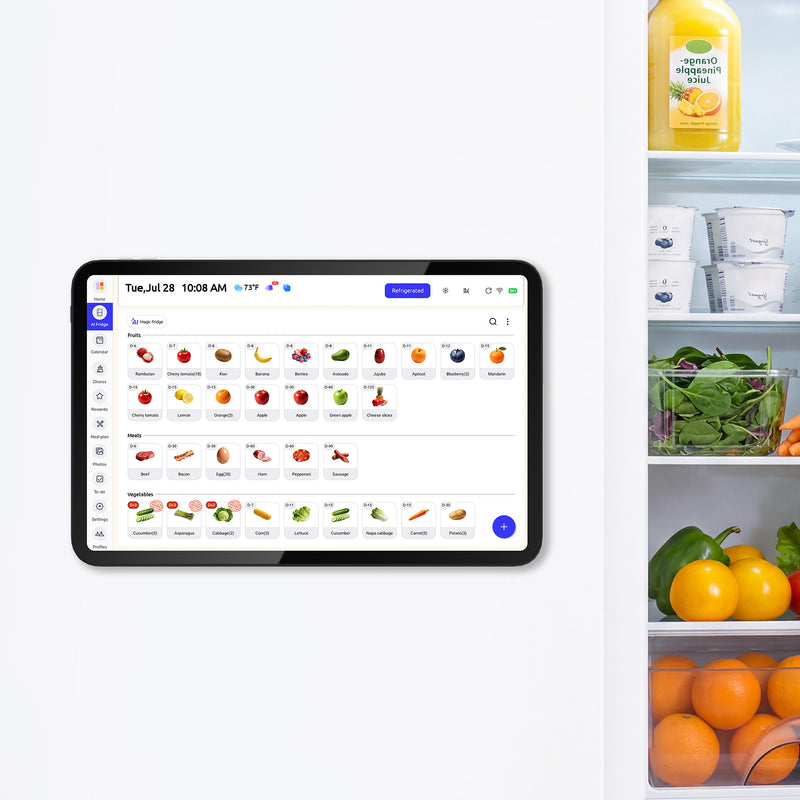
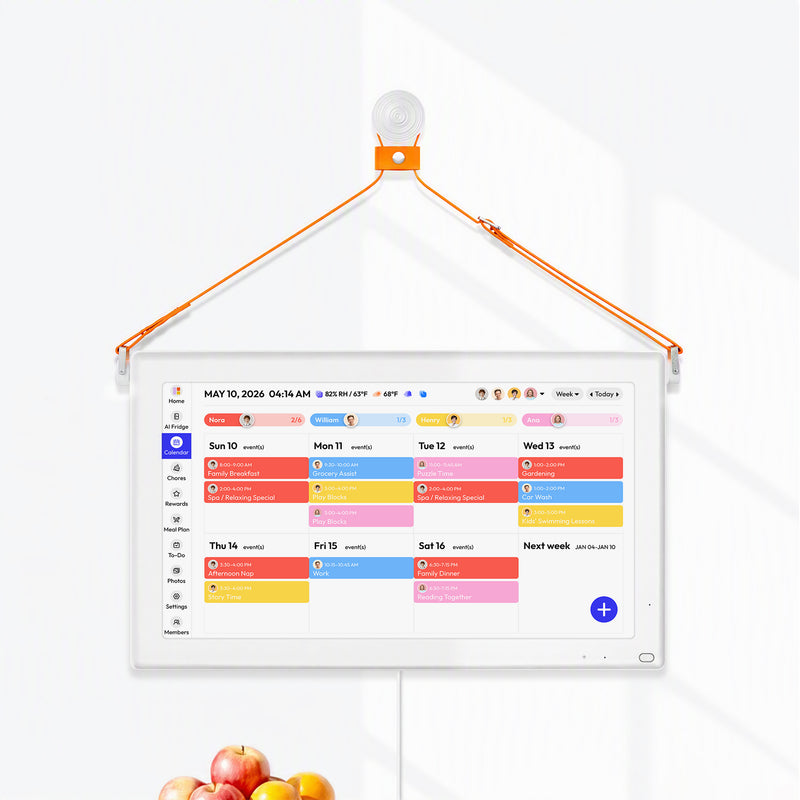
A shared fridge-side view for food, meals, and lists keeps food inventory, expiration reminders, meal plans, and shopping lists together on a magnetic, rechargeable display at the refrigerator. Its companion app provides access away from home, while recipe suggestions can help families consider how to use what they have. The information is easier to see in one place, but families should not assume every inventory update automatically changes the meal plan or shopping list.
Someone must enter or correct food, review reminders, judge storage and safety, and update meals after schedule changes. The tool cannot ensure lower waste, lower spending, or safer food. If maintenance becomes burdensome, reduce the number of tracked items or return to a whiteboard list.
Frequently Asked Questions
What is the easiest way to reduce food waste at home?
Start with one weekly fridge check and a visible use-first zone for safe perishables and dated leftovers. Schedule one flexible meal that can use those foods.
How can I stop buying food I already have?
Check the refrigerator, freezer, and pantry before finalizing one shared list. Add quantities and meal purpose where another shopper could misinterpret the item.
How long are leftovers safe in the refrigerator?
USDA guidance commonly recommends using cooked leftovers within three to four days when they were handled and refrigerated safely. Follow food-specific advice and discard food with uncertain storage history.
Does a best-by date mean food is unsafe?
Often it indicates peak quality, not a universal safety deadline. Consider the product, storage history, package condition, recalls, and special rules such as infant formula.
Can a digital inventory eliminate household food waste?
No. It can make priority food and reminders more visible, but results depend on accurate entries, safe judgment, meal decisions, and family participation.


