



Resentment eases faster when the work of family life is visible, shared, and specific. Another productivity tip cannot fix a household system where one person is still carrying the calendar, meals, chores, reminders, and follow-up in their head.
Ever feel angry about a missing permission slip, an empty fridge, or a forgotten birthday gift, even though the task itself seems small? In many homes, a 10-minute weekly check-in and one shared place for schedules, meals, papers, and chores can reduce repeat arguments because everyone can see what is coming. This article shows what to make visible, what often breaks, and how to build a simple planning rhythm that does not add more pressure.
Why Resentment Builds When Planning Stays Invisible
The problem is not just “too many tasks”
Most family conflict is not only about who unloaded the dishwasher. It is often about who noticed it needed to be unloaded, remembered that the lunch containers were inside it, connected that to tomorrow’s field trip, and followed up before bedtime.
That hidden work is often called the mental load. In plain English, it means planning, remembering, watching for problems, and keeping the household moving. When one person becomes the default keeper of those details, resentment can build even if the other person is doing plenty of visible chores.
A shared planning system helps because it moves information out of one person’s head. Household work tends to cause less friction when it is visible, clearly owned, and reviewed in a short routine instead of handled through repeated reminders, as described in this discussion of household work.
“Can you just?” can become a pressure point
“Can you just pick up milk?” sounds simple. But if one parent had to notice the milk was low, check tomorrow’s breakfast, remember the grocery window, and ask at the right time, the task was not really shared.
This is where many families get stuck. One person becomes the household dispatcher. The other person may feel criticized or micromanaged. Both may feel tired and unappreciated.
Visible planning changes the handoff. Instead of one person issuing reminders, the family uses a shared calendar, meal plan, chore board, or command center to show what needs attention before it becomes urgent.

Why Productivity Tips Often Miss the Family-Life Problem
Parents do not control their schedules like solo workers
A lot of productivity advice assumes uninterrupted time, predictable energy, and control over the day. Parents often have none of those. A sick child, a school email, a late meeting, a missing soccer cleat, or a 47-minute call with health insurance can erase the neatest to-do list.
That is why general productivity tips can make parents feel worse. Mainstream advice often fails when it assumes a parent has full control over the day, while real household management includes interruptions, school prep, meals, laundry, bills, and emotional recovery time working parents.
A better question is not, “How can I become more productive?” It is, “What information does the household need to share so fewer things depend on one person remembering everything?”
Visible planning reduces guessing
Visible planning works because it reduces guessing. Everyone can see that Tuesday has a dentist appointment, Wednesday dinner needs to be fast, Friday has a school form due, and Saturday morning has two activities in different directions.
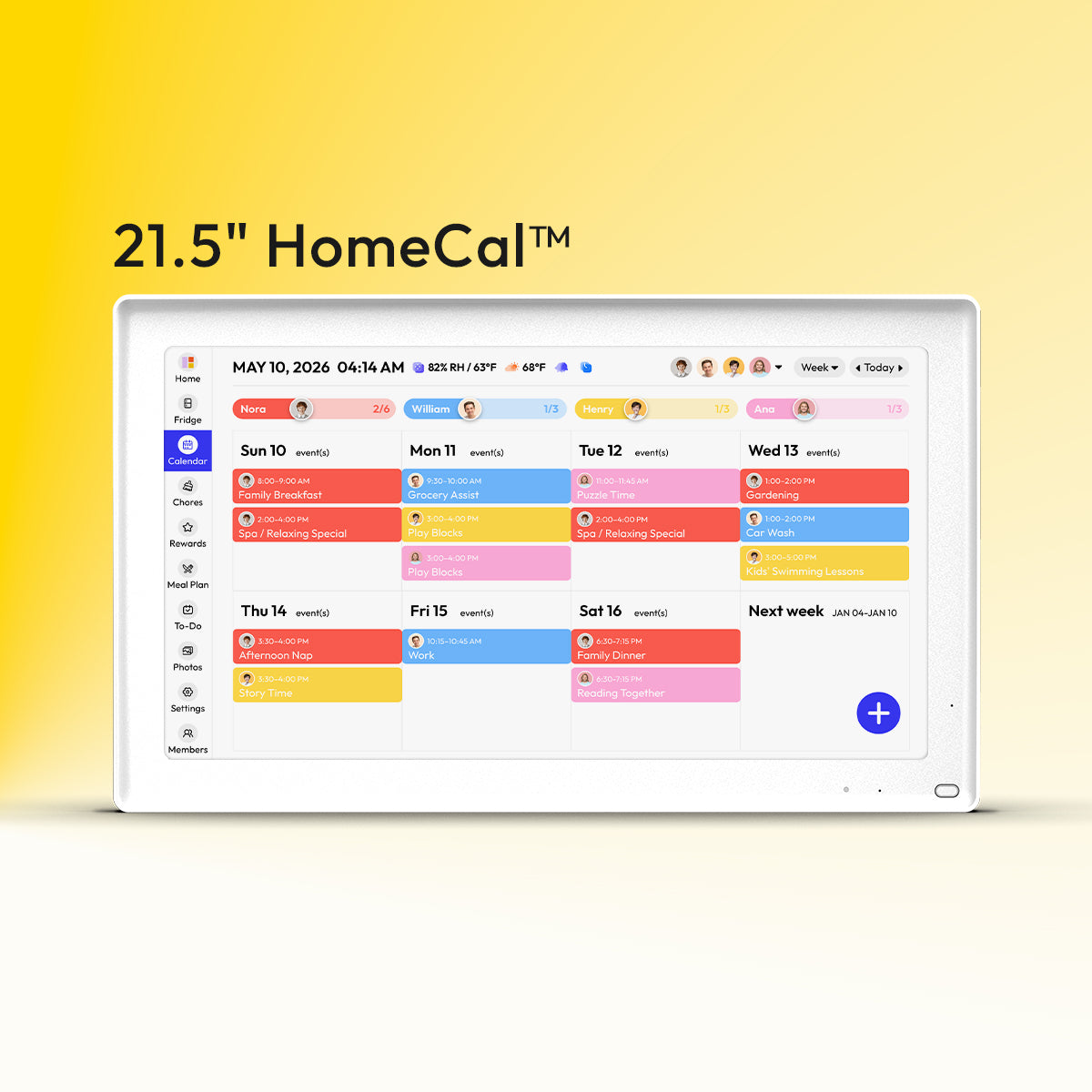
This does not require a perfect system. It requires a shared source of truth. For some homes, that is a digital family calendar on everyone’s cell phone. For others, it is a whiteboard in the kitchen. A wall-mounted shared calendar like the Everblog 21.5" Digital Calendar can fit that role for families who want schedules, chores, and reminders visible in one place. Many families need both: digital syncing for appointments and a visible wall spot for meals, papers, and daily reminders.

When schedules, meals, and chores are displayed in one place, the family can talk about trade-offs before stress peaks. That is different from a productivity tip. It changes the household environment.
What to Make Visible First
Start with schedules, meals, and paper
The most useful visible planning systems usually begin with three categories: time, food, and paper. These are the areas that create many last-minute arguments.
A simple starting setup can fit in about a 2-ft space: one calendar, one landing spot for school or bill papers, and one dinner-planning area. A family command center can include calendars, menus, grocery lists, bills, chore charts, school-paper baskets, clipboards, and pens, but the starter version should stay small enough that people will actually use it visible shared planning.
For example, a kitchen wall might hold a dry-erase monthly calendar, a folder labeled “School,” a grocery list, and a meal plan for Monday through Friday. That is enough to prevent many “I didn’t know” moments.
Make ownership visible too
A task is not fully shared if one person owns the planning and the other person only does the final action. “Dinner” is not one task. It may include checking the calendar, choosing meals, buying groceries, thawing meat, cooking, cleaning up, and packing leftovers.
For unclear duties, define what “done” means. “Laundry” might mean washed, dried, folded, and put away. “School lunch” might mean packed, labeled, and placed in the fridge before 8:30 PM. “Birthday party” might mean RSVP, gift, card, transportation, and calendar entry.
This level of detail is not about keeping score. It is about preventing invisible follow-up from quietly returning to the same person.
How a Family Command Center Helps Without Becoming More Admin
Choose the location before the tools
A family command center works best where people already pass through. Good spots include the kitchen, entryway, laundry room, garage wall, back hallway, or near the back door.
Home organization examples often use narrow walls, closet doors, pegboards, corkboards, magnetic whiteboards, baskets, hooks, labels, clipboards, and file folders to keep schedules and papers in one place family command center. The best version is not the prettiest one. It is the one people can reach while carrying a backpack, lunch box, or grocery bag.

If your household dislikes visual clutter, use the inside of a cabinet or closet door. If papers vanish in hidden spaces, keep the main calendar and paper basket out in the open.
Pick paper, digital, or hybrid based on the failure point
Paper works well for quick scanning. A wall calendar, whiteboard, or chore chart helps children and adults see the week without opening an app.
Digital works well for syncing. A shared calendar lets someone add a work shift, sports practice, school event, carpool, or appointment from a cell phone so the rest of the household sees the update.
Hybrid works best for many busy families. Use a shared digital calendar for appointments and a visible home station for meals, chores, papers, and daily handoffs. Dedicated digital wall calendars can be useful, but they are not required. Some families use an existing tablet, browser, smart display, streaming device, or TV; dedicated displays can range from about $169.99 to $500, while a basic DIY command center may cost about $75 digital wall calendars.
What May Help When ADHD or Executive Function Is Part of the Picture
Make the next action obvious
Executive function is the brain’s ability to plan, start, switch, remember, and follow through. When someone has ADHD traits, high stress, poor sleep, or too many competing demands, those steps can become harder. This is not a character flaw.
Visible planning can support executive function because it lowers the amount of information someone has to hold in working memory. Instead of remembering “everything about Thursday,” a person can look at the board and see: soccer at 5:30 PM, leftovers for dinner, cleats by the door, library book due.

This is support, not treatment. A family calendar or command center does not diagnose ADHD and does not replace medical or mental health care. It simply makes the next step easier to see.
Use fewer categories, not more
A system with 12 labels may look organized and still fail by Wednesday. If someone struggles with attention, task initiation, or overwhelm, keep the visible system blunt and practical.
Use categories like:
- Today
- This week
- Food
- School papers
- Waiting on someone
- Done
Color-coding can help, but only if the meaning is simple. For example, blue for school, green for meals, red for appointments, and black for chores. If people have to decode the system, it will not hold up during a rushed morning.
How to Share the Work Without Turning One Parent Into the Manager
Use a short check-in, not constant reminders
A weekly check-in works better than scattered reminders because it creates one calm place to make decisions. Ten minutes is often enough if the system is visible and current.
Try this rhythm on Sunday evening or Monday morning: review the calendar, choose easy dinners for the busiest nights, assign school-paper follow-up, check transportation, and name one pressure point. If the week is unusually full, remove something where possible instead of pretending the schedule is fine.
Some couples may need a longer reset first. A 30-minute planning exercise can help each person list what they currently manage, compare notes, and decide what should move to the shared system less conflict.
Talk about capacity, not just fairness
Fair does not always mean split exactly in half. A parent working nights, recovering from birth, managing illness, caring for an older relative, or handling a high-stress job may have different capacity from week to week.
The point of visible planning is to make the load discussable. If one parent is carrying more this week, the system should show what that means and what support is needed. It should also prevent temporary imbalance from becoming the permanent default.
This matters during pregnancy and postpartum periods too. Maternal mental health disorders affect up to 1 in 5 expecting and postpartum mothers in the U.S., and stress, anxiety, and depression are linked with unintended pregnancy and reproductive planning pressures maternal mental health. Household planning tools are not healthcare, but shared visibility can reduce avoidable logistical strain during already demanding seasons.
A Simple Visible Planning Checklist
Use this checklist as a starting point, not a standard to perform.
- Choose one shared place. Pick a kitchen wall, entryway, laundry room, garage entry, cabinet door, or digital screen that people naturally pass.
- Add one calendar. Use a paper calendar, shared digital calendar, or wall display. Put appointments, school events, work shifts, practices, travel, and recurring deadlines in one source of truth.
- Create one paper landing spot. Use a basket, folder, clipboard, or tray for school forms, bills, receipts, party invitations, medical papers, and anything that needs a decision.
- Make meals visible. Write down 3 to 5 dinners for the week. Match easy meals to busy nights. Add grocery gaps as soon as someone notices them.
- Assign ownership with follow-through. For each recurring responsibility, name who owns planning, doing, and confirming it is done. Avoid assigning only the final visible step.
- Hold a 10-minute weekly check-in. Review the calendar, meals, transportation, chores, and one likely stress point. Keep it short enough that it can survive a normal week.
- Remove what no one uses after two weeks. If a chart, color, basket, or app is being ignored, simplify it. A smaller system that works beats a detailed system that becomes one more job.
FAQ
Q: Will a shared family calendar really reduce resentment?
A: It can reduce one common source of resentment: invisible coordination. A shared calendar will not solve deeper relationship problems by itself, but it can make schedules, deadlines, and handoffs easier to see. That lowers the number of reminders one person has to carry.
Q: What if my partner does not check the calendar?
A: Start with one visible review point instead of asking for constant checking. For example, look at the calendar together for 10 minutes every Sunday evening. Then connect the calendar to real decisions: who drives, what dinner needs to be, which forms are due, and what can be dropped.
Q: Is a digital family calendar better than a paper command center?
A: Neither is automatically better. Digital calendars are stronger for real-time updates, phone alerts, shared work schedules, and appointments. Paper or wall systems are stronger for quick household visibility, meals, school papers, and younger kids. Many families do best with a hybrid setup.
Practical Next Steps
Visible planning reduces resentment because it changes the household question from “Why didn’t you remember?” to “What does the system show?” That shift matters. It gives tired people a shared map instead of another private list.
Start small this week. Put one calendar where everyone can see it, choose 3 dinners, create one paper landing spot, and hold one 10-minute check-in. If that helps, add chores and recurring responsibilities next. If it creates more work, simplify it until the system is easier than remembering.
The goal is not a perfectly organized home. The goal is fewer surprises, clearer handoffs, and less pressure on any one person to hold the whole family plan alone.
Disclaimer
This article is for household planning education only. It is not a substitute for mental health care, medical advice, legal advice, or crisis support. If safety, custody orders, or a diagnosed condition are involved, work with the appropriate licensed professional.
References
- Mental health impact on the unmet need for family planning and fertility rate in rural Ethiopia: a population-based cohort study
- The Link: Family Planning and Maternal Mental Health
- Split Family Planning: A Couple's Guide to Less Conflict
- 8 Productivity Strategies for Moms Doing it All
- Smart Family Calendar: The Secret to a Cozy, Organized Home
- 21 Smart Family Command Center Ideas


