





Voice has finally become good enough to feel normal. In 2026, most people can speak to an AI assistant naturally, interrupt it, ask follow-up questions, and expect a reasonably competent answer. But that does not mean voice alone is enough. In homes especially, the real bottleneck is no longer speech recognition. It is state visibility.
A family assistant is not just answering trivia. It is tracking pickup times, chore ownership, leftovers, expiration windows, grocery needs, and the difference between “best by” quality guidance and an actual safety risk. Those are not purely conversational problems. They are coordination problems. And coordination works better when information persists on a screen.

Voice Is Excellent for Capture, Weak for Inspection
Voice has a clear advantage at the start of a task. It is fast, low-friction, and useful when hands are wet, busy, or full. Saying “add milk,” “what’s on Thursday,” or “set a timer for the lasagna” is often better than opening an app.
The trouble starts when the task becomes multi-step, comparative, or shared. Spoken information disappears as soon as it is said. That is not just a design preference; it is a long-standing human-computer interaction problem. Speech is transient, hard to review or edit, and can interfere with thinking during more complex tasks. In practice, that makes voice strong for issuing commands and weak for auditing a plan.
That limitation shows up even in the way modern voice products are built. As of April 3, 2026, OpenAI’s Voice Mode FAQ describes voice chats as multimodal, supports screen sharing and video on mobile, and offers captions plus a saved transcript after the conversation. That does not prove every voice interaction needs a display, but it strongly suggests that product teams have learned the same lesson: users often need spoken exchanges turned into visible, persistent information.
The Industry Has Already Moved Past Voice-Only
The best evidence that screens matter is that major assistants no longer behave as if speech is enough.
OpenAI’s current voice experience is built around photo, video, screen sharing, captions, and transcripts. Google took a similar path. In April 2025, its rollout of Gemini Live with camera and screen sharing framed visual assistance around decluttering a space, troubleshooting objects in view, comparing products while shopping, and giving feedback on onscreen work.

That product direction is revealing. When the job is simple, voice works. When the job requires comparison, confirmation, memory, or grounding in the physical world, the assistant reaches for pixels.
A useful 2026 assistant therefore is not “voice-first” in the strict sense. It is voice-for-input, screen-for-understanding.
Homes Need Shared, Glanceable State
The case for a screen gets even stronger in family life because homes are multi-user systems. One person asks, another person acts, and a third person needs to see the result later.
Research on domestic coordination has made this point for years. A study summarized in “The Calendar is Crucial” examined the coordination routines of 44 families and found the family calendar central to awareness and planning. In related field trials, LINC in the Home concluded that a digital family calendar needed to provide at-a-glance awareness from a highly visible location in the home.
That finding still matters in 2026 because AI has changed the input method more than the underlying coordination problem. Families still need a shared surface where schedules, reminders, and responsibilities remain visible after the conversation ends. A spoken reminder helps one person in one moment. A wall or fridge display helps the household.
This is why a screen in the kitchen, hallway, or family command center is not just decorative hardware. It is an external memory system. It reduces the need for one adult, usually the most overloaded one, to keep the whole household model in her head.

Food Science Makes the Argument Stronger
Meal planning and food management are where voice-only assistance breaks down fastest.
Food safety depends on thresholds and time windows, not just answers to isolated questions. The FDA recommends keeping a refrigerator at 40°F or below. The USDA’s food dating guidance explains that common date labels such as “Best if Used By” and “Sell By” generally indicate quality, not safety. The USDA’s leftovers guidance says most leftovers should be eaten within 3 to 4 days in the refrigerator.
Those facts are easy for an assistant to recite. The hard part is operationalizing them in a real kitchen. Which leftovers are on day three? Which yogurt expires first? Which produce should be used tonight? Which ingredients mean dinner can be made without another store trip? A voice assistant can answer one of those questions at a time. A screen can show all of them at once.
That matters because the stakes are not trivial. USDA estimates that 30% to 40% of the U.S. food supply goes uneaten, and the same page notes that the average American family of four loses $1,500 each year to uneaten food. That does not prove a screen alone solves household food waste. It does show that visibility is a legitimate design target, not a cosmetic upgrade.
In food science terms, many home decisions are time-temperature-and-inventory problems. Those are better managed with persistent visual cues than with disappearing audio.
What a Truly Useful Home Assistant Should Show
A capable home assistant in 2026 should treat the screen as a working surface, not as a secondary accessory.
It should show confirmation after voice capture. If someone says “add chicken thighs for Tuesday,” the result should become visible immediately in the meal plan and shopping list.
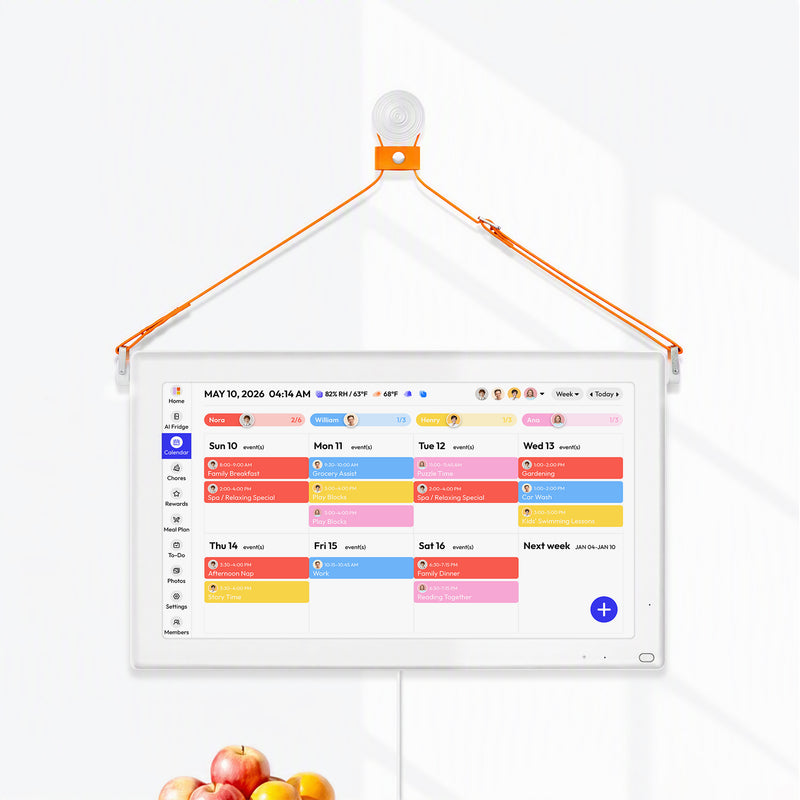
It should keep shared state persistent. Family calendars, chores, grocery lists, and meal plans should remain glanceable without requiring a new conversation every time.
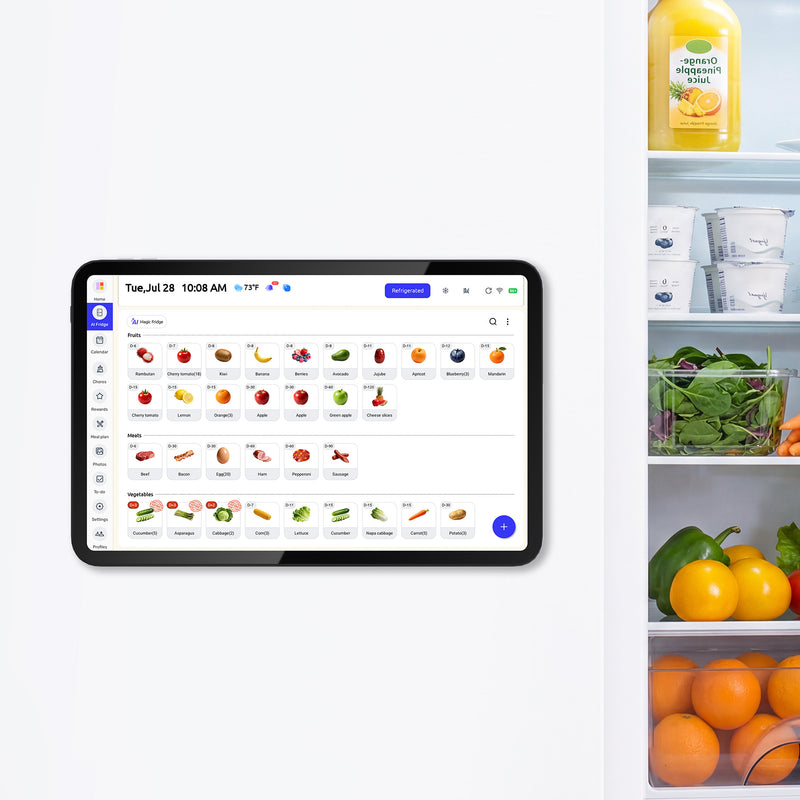
It should visualize time-sensitive food information. Expiration alerts, leftover age, and fridge status are more useful as countdowns, labels, and color cues than as one-off spoken reminders.
That view should also label whether a date came from manual entry or a device reading, and uncertain cases should appear as editable, low-confidence state rather than false precision. When storage history is incomplete, the safer design is an earlier warning buffer, not a more authoritative-looking countdown.
It should support comparison. Side-by-side options for recipes, schedules, or grocery substitutions are far easier to judge visually than through a sequence of spoken suggestions.
It should live where the decision happens. Kitchen workflows benefit from fridge or counter placement; schedule coordination benefits from a larger shared display in a common area.

That surface also needs recovery and privacy safeguards. Research on shared smart speaker privacy risks makes the design requirement concrete, so misheard commands should stay editable, shared or destructive actions should ask for confirmation, sensitive reminders should support per-person visibility and owner controls, and the interface should keep a visible history so households can spot when voice and screen state have drifted.
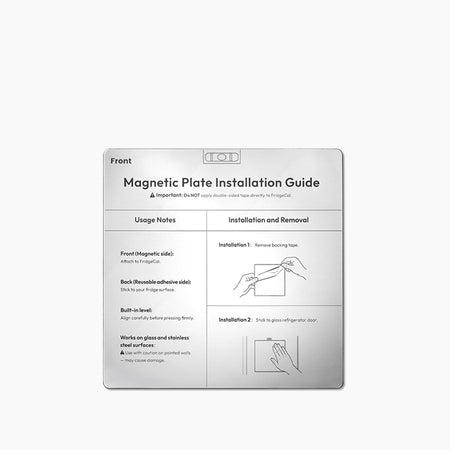
That placement logic explains why different screen formats exist. A wall-mounted shared planner such as the a company fits the family-coordination problem: a large shared view with calendar sync, tasks, and chores. A kitchen device such as the a company fits the food-management problem: fridge visibility, expiration alerts, meal planning, and grocery lists at the point of use. The important point is not the brand. It is that screen size and location should match the household job being done.
Conclusion
The useful question in 2026 is no longer whether voice assistants can talk well enough. They can. The real question is whether they can hold a household’s changing state in view.
For simple commands, voice-only interaction is often sufficient. For family coordination, home organization, and meal planning, it usually is not. Screens provide persistence, shared awareness, comparison, and trust. They turn an assistant from a fleeting conversation into a usable system.
In that sense, the screen is not a bonus feature for AI assistants. It is the part that makes voice practical.
Disclaimer
This guide is provided for informational and educational purposes only. While we prioritize accuracy based on current food science, storage safety standards can vary significantly depending on specific product ingredients, regional climates, and local health regulations. This content is not a substitute for official safety protocols provided by government organizations such as the FDA or USDA. Always inspect food products for signs of spoilage and follow manufacturer-specific storage dates before consumption.
References
- The Limits of Speech Recognition
- OpenAI Voice Mode FAQ
- 5 ways to use Gemini Live with camera and screen sharing
- “The Calendar is Crucial”: Coordination and Awareness through the Family Calendar
- LINC in the Home: Field Trials of a Digital Family Calendar
- Refrigerator Thermometers: Cold Facts about Food Safety
- Food Product Dating
- Leftovers and Food Safety
- Food Loss and Waste
- Everblog 21.5" Digital Calendar
- Everblog 13.4" FridgeCal Calendar


