

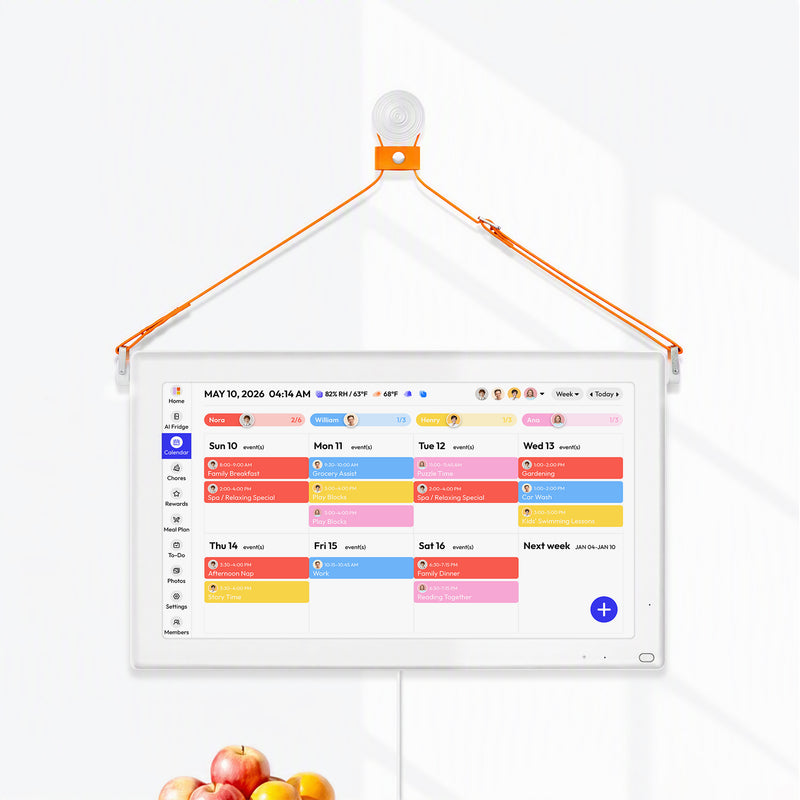



A digital wall calendar is a shared calendar shown on a screen that stays in a common part of the house. In everyday family life, it works like a living schedule board that updates itself, so school pickups, practice times, dinner plans, and chores are visible without one person having to remember everything.
Unlike a paper calendar, a digital wall calendar is usually connected to accounts your family already uses. That means a change made on a phone, laptop, or tablet can show up on the home display too, and shared calendars can be set so other people can only view events or can also edit them in Google Calendar, iCloud Calendar, and Outlook.
What a Digital Wall Calendar Actually Is
At its simplest, it is three things at once:
- A screen in a visible place, often a kitchen, hallway, mudroom, or family room.
- A shared planning view that shows multiple people’s schedules together.
- A sync point that reflects changes from connected calendar apps and, in some setups, lets you make changes from the wall screen itself.
The important part is not the screen size or the brand. The important part is visibility. If the family can see the plan while walking by, the calendar becomes part of daily life instead of another app hidden on a phone.

That is why people often call these devices a “family command center.” The screen becomes the place where everyone checks what is happening today, what is due tomorrow, and who is supposed to do what.
How It Works Day to Day
Most digital wall calendars do not replace your existing calendar accounts. They sit on top of them.
A common setup looks like this:
- One or two adults connect existing calendar accounts, such as Google, Apple, or Outlook.
- The screen pulls those events into one household view.
- Each person gets a color, label, or separate calendar layer.
- The family can glance at the screen for the day’s schedule.
- New events or edits made from a phone or computer update on the shared display.
A practical setup path is simple: create one household calendar, add the adults who should edit it, give everyone else view-only access, connect that same calendar to the wall display, and then test one phone-made edit on the screen; Google Calendar separates people who can only see details from people who can make changes, which is the clearest way to decide whether the wall device should be editable or display-only.
That last part is what people usually mean by “sync.” With cloud-based calendars, updates made on one device can appear on the others automatically, as Apple explains for iCloud calendars across devices here.
In a busy home, that can look very ordinary, which is the point. A parent adds a dentist appointment from work. A teen sees it on the wall after school. Another adult notices it overlaps with soccer practice. Someone shifts dinner later. The schedule changes once, and the whole house can see the new version.

Shared Calendar Terms in Plain English
A few terms show up often when people shop for or set up these systems:
Shared calendar
A calendar more than one person can access. Depending on permissions, other people may only see events, or they may also be allowed to edit them.
Sync
Updates move between devices and accounts so the same event does not need to be entered more than once.
Subscription calendar
A calendar feed you add to view updates from somewhere else, such as a school schedule or sports calendar. This is often better for read-only information than for family editing.
For school, sports, or club schedules, use a subscribed feed instead of a one-time file upload: in Outlook.com, a web subscription keeps later changes coming through, while an imported .ics file stays a snapshot; in plain language, import = fixed copy, subscription = future updates.
Touchscreen hub
A screen you can tap to view, add, or manage calendar items, chores, lists, or meal plans.
Family command center
A shared home planning spot, usually in a high-traffic area, where schedules, reminders, and household tasks stay visible.
What Matters Most in a Real Family Home
The best digital wall calendar is not the one with the longest feature list. It is the one that matches how your family already moves through the house.
These details matter most:
- Readability from across the room. A wall calendar should be easy to scan while you are packing lunches or walking in with groceries.
- Fast input. If adding an event takes too many taps, people stop using it.
- Clear ownership. Color coding helps when one screen holds school, work, pickup, and activity schedules at once.
- Reliable sharing rules. You need to know who can edit, who can only view, and what stays private.
- Placement. A device in the kitchen may get checked ten times a day. A device in a spare room may get ignored.
- Extra tools only if they fit your routine. Chores, meal planning, grocery lists, and reminders are useful when they reduce friction, not when they create another system to maintain.

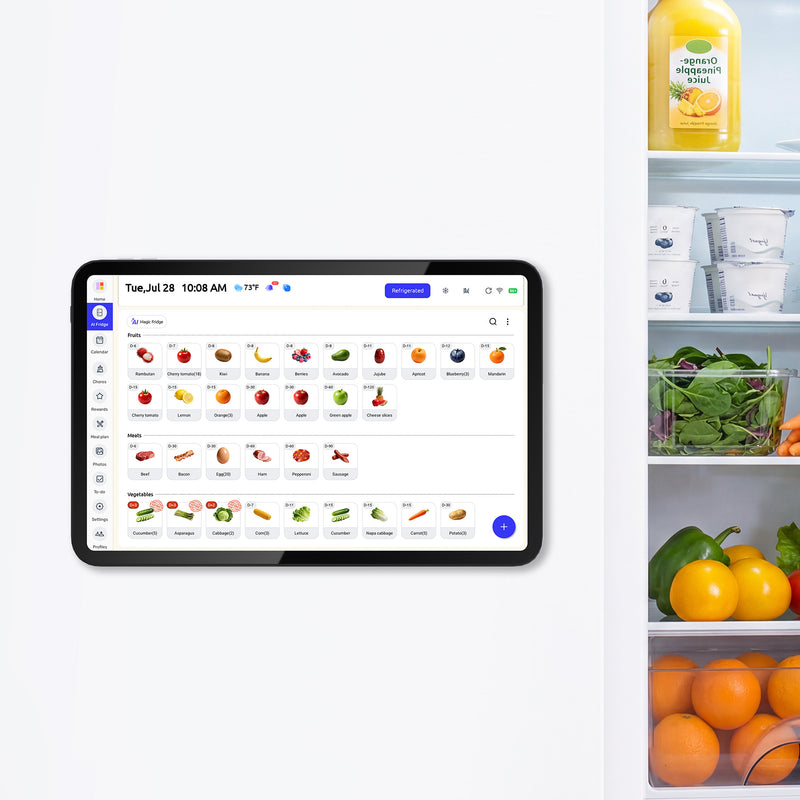
For families who want a fixed shared screen rather than checking a tablet or laptop, a large wall-mounted option such as the a company can make sense as a dedicated household display that brings calendars, tasks, chores, and events into one visible view.
Where Digital Wall Calendars Help Most
These systems tend to help most when the family has repeat coordination problems, not just a vague wish to be “more organized.”
They are especially useful when:
- Two or more adults manage overlapping work and school schedules.
- Kids are old enough to check the screen themselves.
- Pickups, practices, and after-school activities change often.
- Chores need to be visible instead of verbally assigned over and over.
- Dinner planning, grocery reminders, or fridge checks are part of the same daily routine.
In other words, a digital wall calendar is strongest when it replaces repeated conversations. If your household keeps asking, “What’s happening tonight?” or “Who is picking up?” a visible shared screen can remove a lot of that repetition.

Limits and Trade-Offs
A digital wall calendar is still just a tool. It does not solve bad habits on its own.
It also helps to know where the limits are:
A wall display is public by design. That is helpful for normal family logistics, but it also means private appointments or sensitive notes may belong on a personal calendar layer instead of the main family screen.
Cross-platform sharing can also get messy at the edges. Private iCloud calendar sharing requires invitees to have an Apple Account and use iCloud, while public iCloud calendars can be shared more broadly by link here. Outlook has its own quirks too: when an Outlook.com calendar is shared with non-Outlook users such as Gmail users, Microsoft notes they may need an Outlook.com or Microsoft 365 account to accept the invitation here.
There are also differences between true sharing and simple publishing. In Outlook, published HTML and ICS calendars are read-only, and imported ICS files do not keep updating unless the recipient subscribes instead of just importing here. Google has a smaller but practical limitation too: subscribing to someone else’s Google calendar must be started in a computer web browser, not in the mobile app here.
Work and school calendars may be restricted as well. In Google Calendar, admins can control whether a work or school calendar can be shared outside the organization here.
- Default rule: one or two adults manage sharing and edits on the household calendar, and everyone else starts as view-only.
- Sensitive items such as medical, counseling, legal, or surprise events belong on a personal layer or should be marked private in Google Calendar.
- Platform limits are not identical: private iCloud calendar sharing requires an Apple Account and iCloud, so mixed-device families may need a different shared master calendar.
- Permission models differ too: Outlook on the web can give people view, edit, or delegate access, which is worth checking before you expect the wall screen to support direct editing.
The Practical Bottom Line
A digital wall calendar is best understood as a household visibility tool, not just a screen with dates on it. It takes scattered plans from phones and inboxes and puts them in one place where the whole family can act on them.
For a busy family home, that is the real value: fewer missed handoffs, fewer duplicate reminders, and less schedule knowledge trapped inside one person’s head.
FAQ
Q: Can a digital wall calendar replace everyone’s personal calendar?
A: Usually no. It works better as the shared household view that sits on top of personal calendars. People still keep private appointments or work-only items in their own accounts when needed.
Q: Do all digital wall calendars let you edit events on the screen?
A: No. Some are full touchscreen planners, while others mainly display synced or subscribed calendars. Check whether the system supports true editing, or only read-only calendar feeds.
Q: Is a kitchen the best place for one?
A: Often yes, because it is where families naturally stop and look. But the best location is the place everyone already passes several times a day, such as a hallway near the door, a mudroom, or the fridge area.
References
- Google Calendar Help: Share your calendar
- Google Calendar Help: Subscribe to someone else’s calendar
- Apple Support: Keep your calendars up to date and share them with iCloud
- Apple Support: Share a calendar on iCloud.com
- Microsoft Support: Share your calendar in Outlook.com
- Everblog 21.5" Digital Calendar
- Everblog 13.4" FridgeCal Calendar


